


- Published on: 2026-10-28 03:04:51
What a broker failure means for your investments and cash

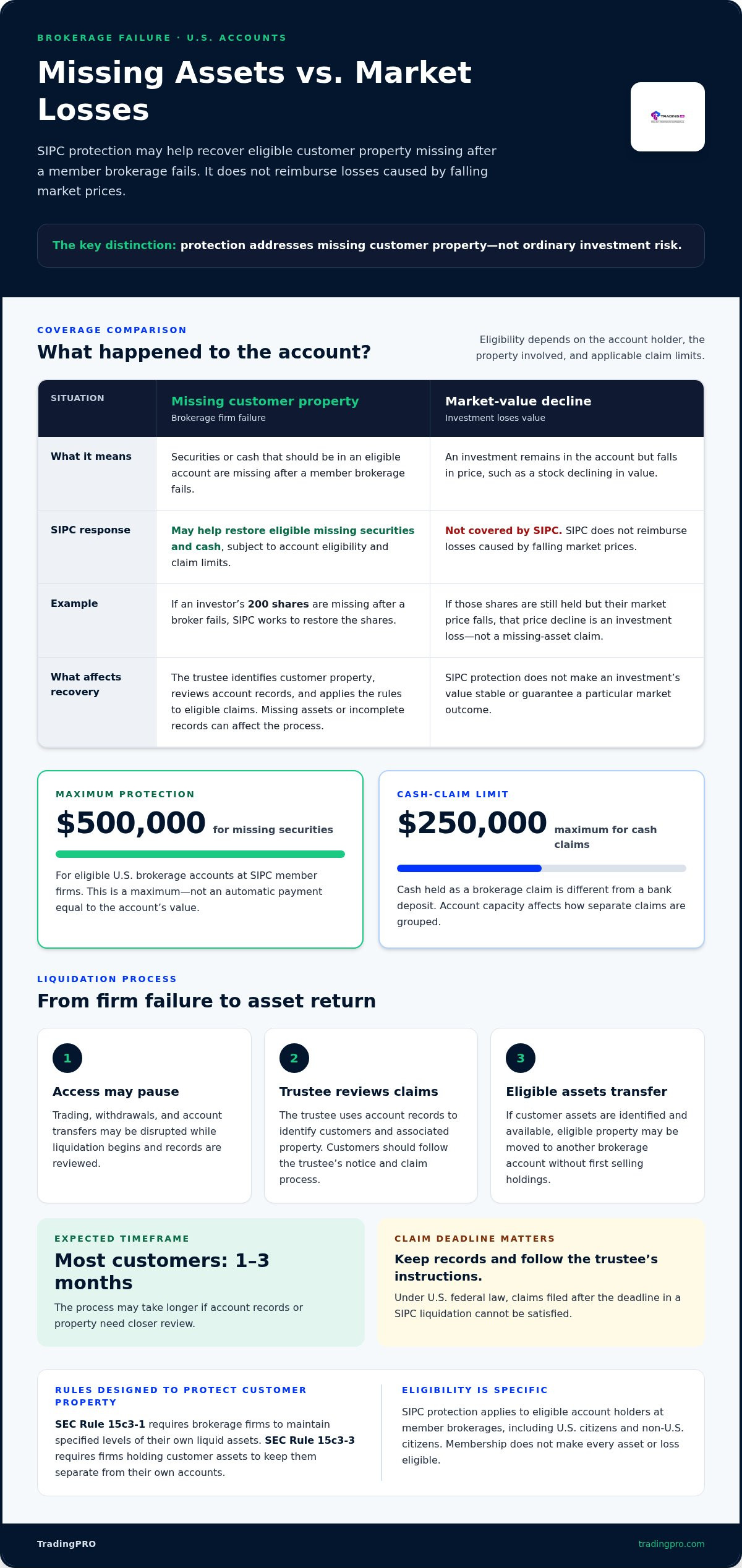
A brokerage failure doesn’t automatically erase your investments. In the United States, SIPC protection can cover missing securities in an eligible account up to $500,000, including up to $250,000 for cash claims. Understanding what happens if my broker goes bankrupt starts with a key distinction: SIPC may help recover missing assets, but it doesn’t reimburse losses caused by falling market prices.
It’s natural to worry about losing access to your investments or cash. After a U.S. brokerage liquidation begins, most customers can expect to receive their assets in one to three months, although trading and transfers may be disrupted temporarily.
This article explains how customer assets are handled, how account transfers and SIPC claims work, and what protection does and doesn’t cover. It also explains how a broker’s failure differs from the bankruptcy of a company whose shares you own, so you can identify which situation affects your account.
Key Takeaways
- Separate a brokerage firm’s financial failure from a decline in your investments’ market value; the protections and recovery process differ.
- Learn how U.S. rules on broker capital and customer-asset segregation are designed to protect client property.
- Understand why account access and trading can be disrupted during liquidation, and what the trustee’s transfer and claims process involves.
- Compare SIPC protection for brokerage accounts with FDIC insurance for eligible bank deposits.
- Distinguish broker failure from a company bankruptcy, where the outcome for shareholders depends on the company’s restructuring or liquidation.
Broker Bankruptcy: What Happens To Your Investments?
A broker’s failure doesn’t automatically mean your investments disappear. In the United States, capital rules, customer-asset segregation, and Securities Investor Protection Corporation (SIPC) proceedings all affect what customers may recover.
Broker Capital and Asset Segregation
Broker capital rules set minimum financial resources, while segregation keeps customer assets separate from a firm’s own property. Both measures help distinguish customer holdings from the brokerage’s finances when the firm fails.
SEC Rule 15c3-1, known as the Net Capital Rule, requires U.S. brokerage firms to maintain specified levels of their own liquid assets. SEC Rule 15c3-3, known as the Customer Protection Rule, requires firms holding customer assets to keep them separate from their own accounts. These rules reduce the risk that customer property will be treated as ordinary firm assets.
Segregation doesn’t guarantee that every asset will be available immediately. If records are incomplete or assets are missing, a trustee may need to identify customer claims and reconcile account records before returning property.
SIPC-Protected and Excluded Assets
SIPC protection is designed to help customers recover eligible securities and cash missing from an account when a member brokerage fails. It doesn’t protect investments from market declines.
For example, if an investor held 200 shares and those shares were missing after a broker failed, SIPC would work to restore the shares, not reimburse a fall in their market price. The distinction is central: securities investor protection addresses missing customer property, not ordinary investment risk.
SIPC coverage applies to eligible account holders at member brokerages, whether they’re U.S. citizens or not. Eligibility also depends on the account holder and the type of property involved. A market loss, such as a stock falling in value while held in the account, isn’t a missing-asset claim.
To check whether a broker is a SIPC member, search its legal name in SIPC’s member directory and match it to the brokerage that holds your account. Membership doesn’t make every asset or loss eligible for protection.
Asset Return Timing and Protection Limits
For eligible U.S. brokerage accounts, SIPC protection covers missing securities up to $500,000, including a maximum of $250,000 for cash claims. The limits apply to claims in a separate capacity; account capacity affects how claims are grouped.
After liquidation begins, most customers can expect to receive their assets in one to three months. The process may take longer if account records or property need closer review. Until assets are transferred or released, trading and withdrawals may be limited.
These limits describe the maximum protection available, not an automatic payment equal to an account’s value. Recovery depends on the eligible missing property and applicable claim limits. Cash held as a brokerage claim is also different from a bank deposit, so the relevant protection depends on where the funds are held.
Missing Assets and Protection Gaps
If an account exceeds SIPC limits or assets are missing, SIPC protection may not cover the full account value. The trustee identifies customer property and claims, then applies available assets and protection rules to eligible claims.
Claims above applicable limits can leave a shortfall if the firm’s remaining customer property cannot cover them. SIPC may use a direct-payment procedure when all customer claims in a brokerage failure are within the stated $250,000 aggregate limit. That procedure doesn’t change the general coverage ceiling.
Keep account statements and transaction records to support the holdings shown in your account. If liquidation begins, follow the trustee’s claim process and deadline. Under U.S. federal law, claims filed after the deadline in a SIPC liquidation cannot be satisfied.
How brokerage liquidations and account transfers work
A U.S. brokerage liquidation shifts control of account records and customer claims to a trustee. The Securities Investor Protection Corporation (SIPC) and trustee work to identify customers who held accounts with the firm during the previous 12 months.
From liquidation to customer notice
Liquidation can interrupt ordinary account access. Investors may be unable to transfer accounts or execute trades, making an account temporarily difficult to manage. After receiving the initial account-transfer notice, customers should file a claim with the trustee.
The trustee uses account records to identify customers and the property associated with their accounts. This helps distinguish an individual customer’s securities and cash from the brokerage firm’s own assets. Keep statements and transaction confirmations together so you can compare your records with the notice and claim details.
How transfers can restore access
If customer assets are identified and available for transfer, securities and other eligible property can be moved to another brokerage account. A transfer may restore access without requiring you to sell your holdings first. The process depends on the liquidation and the trustee’s instructions, so follow the notice rather than assuming ordinary account-transfer procedures apply.
Trading may remain unavailable while account records are reviewed or property is transferred. For example, an investor who planned to sell a security during the interruption might be unable to place the trade. This disruption doesn’t prove that the security has lost market value or that the investor’s claim has been resolved.
Separate-capacity accounts
SIPC coverage is calculated separately for each account held in a distinct capacity. Capacity means the legal way an account is owned, so separate registrations may be treated differently from multiple accounts held in the same capacity. Registration and ownership details matter when claims are grouped and reviewed.
Before filing, review the account name and registration on your statements. Give the trustee accurate details for each account, then compare the transfer notice with your records. If the information differs, report the discrepancy through the claim process so the trustee can assess the correct ownership capacity.
Once you’ve resolved an existing account issue and are considering a new trading setup, you can explore account registration options.
Recovery statistics for SIPC-eligible investors
Past SIPC recovery figures show the scale of assistance in brokerage failures, but they don’t predict the outcome of an individual claim. The key is to identify whether the loss involves a failed broker, an insured bank deposit, or an investment that lost market value.
What recovery figures show
Assistance can help eligible investors recover assets after a brokerage failure. SIPC also advanced $3.1 billion to help make those recoveries possible. These figures describe completed assistance across cases, not a promise that every customer receives every asset or the value originally shown on an account statement.
SIPC states that no fewer than 99 percent of eligible persons get their investments back with its help. Eligibility and the property involved still matter. SIPC protection concerns eligible customer property missing after a brokerage failure; it doesn’t cover an investor’s loss when a security falls in market value. That distinction helps explain why a securities investor’s recovery may differ from an account’s former balance.
SIPC and FDIC protect different holdings
Currently, the practical distinction is where the funds are held. SIPC addresses eligible customer property at a member brokerage when the firm fails, while FDIC deposit insurance applies to qualifying deposits at insured banks. The Federal Deposit Insurance Corporation covers up to $250,000 per depositor, per insured bank, and per account ownership type.
Bank deposits and brokerage cash follow different protection systems. For example, cash in an insured bank deposit is assessed under FDIC coverage, while cash held in a brokerage account is considered under SIPC rules. Identify which institution holds the funds before deciding which process applies.
Submitting a claim and observing deadlines
If a SIPC liquidation begins, follow the trustee’s notice and claim instructions. Compare the account information with your statements, list the securities or cash you believe are missing, and provide the requested records. The trustee reviews customer claims and account records during the liquidation.
File by the deadline stated in the liquidation notice. Under U.S. federal law, claims filed after the deadline in a SIPC liquidation cannot be satisfied. Keep copies of your claim and supporting documents in case the trustee requests clarification.
If your broker closes or files for bankruptcy, preserve account statements and transaction records, then follow the trustee’s claim instructions and deadline. Don’t treat a market decline as a missing-asset claim, because the distinction affects what SIPC can address.
Broker failure versus the bankruptcy of a company whose stock you own
A brokerage firm and a company whose stock you own are separate businesses, so their failures affect different things. If the broker fails, the issue is access to or recovery of customer assets held through the firm. If the stock issuer fails, its financial condition affects the investment itself. This distinction helps identify whether the concern is custody, market value, or both.
When the brokerage firm fails
Suppose you hold shares of a public company through a brokerage account and the brokerage firm enters liquidation. The broker’s failure doesn’t, by itself, mean the share issuer has gone bankrupt. The liquidation focuses on identifying customer property and claims. SIPC protection may address eligible securities missing from an account, but it doesn’t compensate for a fall in share price.
As noted earlier, trading access can be interrupted during a brokerage liquidation. That disruption concerns your account relationship, not necessarily the operations of the companies represented by its securities. If the issuer continues operating, its shares may retain market value even while your account is subject to transfer or claim procedures.
Separate two questions: are the securities present and recorded as customer property, or has the issuer’s financial position weakened? A statement showing a holding can help identify securities associated with your account. It doesn’t establish that the shares will retain their value or that a broker-failure claim covers investment losses.
When the stock issuer files for bankruptcy
A company bankruptcy directly concerns the issuer’s debts and business. In Chapter 11, the company may continue operating while restructuring its debts. Existing common shares are often cancelled or heavily diluted, so shareholders can lose value even if the company remains open during restructuring.
Chapter 7 follows a different path. The company sells its assets and shuts down, while creditors are paid before common shareholders. As a result, common shareholders typically recover little or nothing. That outcome stems from the issuer’s bankruptcy, not from a brokerage firm losing or misplacing customer assets.
Consider an investor who holds stock in a company entering Chapter 11 while their brokerage remains operational. Their concern is the issuer’s restructuring and the possible cancellation or dilution of existing shares. If the brokerage itself fails instead, the investor’s first concern is the custody and recovery of account property. If both companies fail, both risks can apply, but each has a distinct cause and process.
Use the company named on the bankruptcy notice to identify the event. A notice naming the broker points to account handling; one naming a stock issuer points to the investment’s prospects. SIPC coverage addresses eligible missing brokerage property, not the business outcome of a bankrupt stock issuer.
What happens when a brokerage firm fails
A brokerage firm’s financial trouble can affect account access before customers know how their assets will be handled. In the United States, contact the firm for its procedures. Then distinguish an operational disruption from a formal liquidation: the notices, account records, and instructions determine what to do next.
Regulatory requirements provide context, but they don’t prevent every failure. The Securities Investor Protection Act was enacted in 1970 to establish SIPC’s role in protecting brokerage customers against certain losses when a broker fails financially. Broker-dealers registered under the Securities Exchange Act of 1934 must be SIPC members. More than 3,200 brokerage firms are SIPC members, but membership doesn’t turn market losses into protected claims.
Financial reporting offers another perspective on a brokerage firm’s condition. U.S. brokerage firms that do business with public customers must have their financial statements audited annually by an independent accounting firm. Publicly traded U.S. brokerage firms must file quarterly, annual, and other periodic reports with the SEC. These disclosures can help investors review a firm’s finances, but they don’t guarantee that it will remain financially sound.
If the firm announces financial trouble, focus on official communications and preserve account statements, transaction records, and messages. Compare the holdings on your latest statement with any account or transfer notice. If liquidation begins, follow the trustee’s instructions and submit the required claim by the stated deadline. Don’t assume normal trading, withdrawals, or transfers will continue.
Identify which entity has failed. A brokerage firm’s failure concerns the custody, records, or recovery of customer property. A stock issuer’s failure concerns the value and prospects of its shares. If your account contains stock in a company facing bankruptcy while the brokerage remains open, the issuer’s condition is the central issue. If the broker is in liquidation, account handling is central.
The practical takeaway is to act on the event described in the notice, not on rumors or a falling share price alone. Contact a financially troubled firm about its procedures, retain records, and follow any trustee claim process. For a separate trading setup after reviewing your account situation, register for a trading account.
TradingPRO: Rookie Account
TradingPRO’s Rookie Account is an option to explore after you understand how brokerage failures and recovery claims work. Opening a new account is separate from resolving an existing account issue: it doesn’t recover missing assets or change a claim against a failed brokerage.
Choose your next step based on your trading plans, not assumptions about investor protection. SIPC eligibility depends on the brokerage and the circumstances of a failure, not simply on the account name. TradingPRO also offers Micro, Pro, and Scalp Accounts for different trading approaches. Review the account options and consider which setup fits your intended activity.
Contact TradingPRO to learn more about the Rookie Account.
Move forward with a clear plan
Understanding what happens if my broker goes bankrupt can help you make measured decisions instead of reacting to alarming headlines. Pause, identify the decision in front of you, and separate immediate account concerns from longer-term trading goals. A deliberate approach can keep one firm’s difficulties from dictating your next move.
Preparedness isn’t about predicting every disruption. It means making choices with a clear view of your priorities, time horizon, and risk tolerance. Keep your own objectives in focus, and avoid rushing into a trading decision simply because the market feels uncertain.
If you’re ready to explore a trading account for your next step, visit TradingPRO to get started. Move forward with focus and confidence.
Frequently Asked Questions
What Happens When a Firm Fails?
If you’re asking what happens if my broker goes bankrupt, account access and asset handling depend on the firm’s situation and any liquidation process. First, identify whether the notice describes financial trouble, formal liquidation, or an account transfer. Contact the firm for its procedures, keep your account statements, and follow trustee instructions. A brokerage’s failure doesn’t mean companies represented in your account have also failed.
What Happens to My Stocks If My Broker Goes Out of Business?
Your stocks don’t automatically become worthless because a brokerage closes. The key question is whether the securities are recorded as customer property and can be transferred or returned through liquidation. Trading access may be interrupted while records are reviewed. A stock, for example, may still have market value even if you temporarily can’t trade it through the failed broker.
Do Stockbrokers Ever Go Bankrupt?
Yes. A brokerage firm can face financial trouble and fail, after which customers may encounter liquidation and a trustee handling claims. “Bankruptcy” can also describe the failure of a company whose shares you own, which is a different event. Check the name on any notice: a broker’s failure affects account custody, while an issuer’s failure affects its stock.
Is my money safe in a brokerage account?
A brokerage account isn’t risk-free: investments can lose market value, and access may be disrupted if the firm fails. SIPC protection may help with eligible missing brokerage property, subject to its rules and limits. Brokerage cash is also different from a bank deposit. The Federal Deposit Insurance Corporation covers qualifying deposits at insured banks, so identify which institution holds your funds.
What Happens in a SIPC Liquidation?
In a SIPC liquidation, a trustee reviews account records, identifies customers and their property, and handles claims. Read the trustee’s notice carefully, compare its account details with your records, and submit the requested claim by the stated deadline. Keep a copy of your filing. Trading or account transfers may be unavailable while the review proceeds.
What Is SIPC Protection?
SIPC is a U.S. system that helps eligible customers recover certain missing property when a member brokerage fails financially. It addresses qualifying securities and cash claims, not investment performance. If a stock remains in your account but falls in price, that decline isn’t a missing-property claim. Eligibility depends on the account and property involved, which the claim process evaluates.
What happens to my stocks and cash if a U.S. brokerage firm goes bankrupt?
To understand what happens if my broker goes bankrupt, distinguish missing account property from market losses. A trustee may review account records and arrange a transfer or assess a claim for missing assets. A fall in stock prices remains an investment loss. Keep statements and transaction records so you can compare your holdings with the trustee’s account information.
How does SIPC protection work, and what are its limits per customer and account type?
SIPC protection covers eligible missing securities up to $500,000, including a maximum of $250,000 for cash claims. The limit applies to each account held in a separate capacity, so ownership registration matters when accounts are grouped. Separate capacities are assessed distinctly; multiple accounts with the same ownership capacity aren’t automatically treated as separate limits. The trustee reviews account registrations and eligible claims.


