


- Published on: 2026-11-22 18:01:35
Managing Trade Size During Volatile Opening and Closing Hours

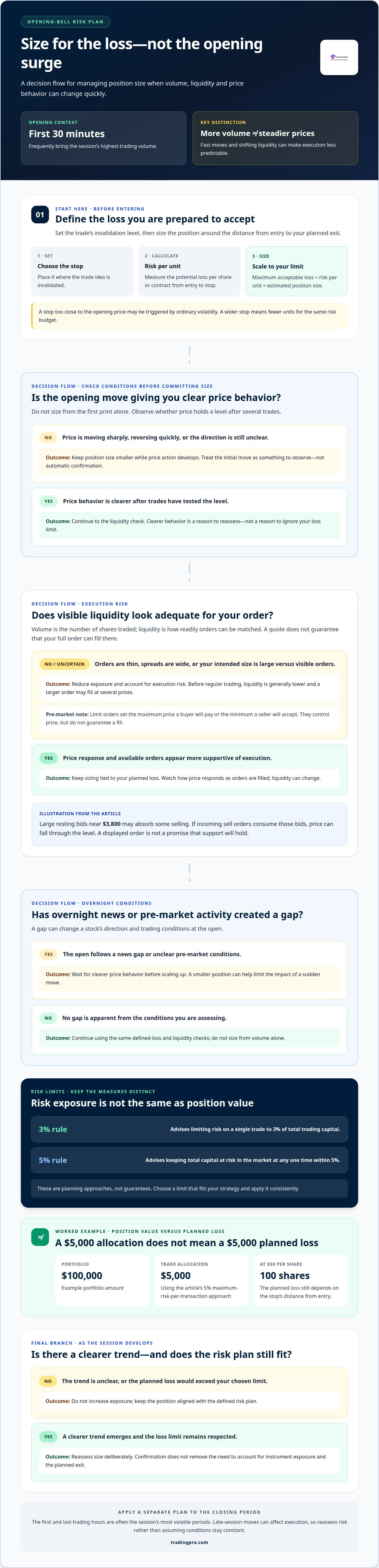
Managing trade size during market opening bells starts with treating the opening minutes as a higher-risk period, not a signal to commit more capital. The first 30 minutes frequently bring the session’s highest trading volume, while fast price moves and shifting liquidity can make execution less predictable. Reduce exposure while the market establishes direction, and base your position on the loss you’re prepared to accept and the distance to your exit point.
It’s natural to expect heavier opening volume to make trades easier to execute. But volume alone doesn’t guarantee stable prices or tight spreads, especially when overnight news or pre-market conditions have created a gap. A smaller position can help prevent a sudden move from turning a trading decision into an outsized loss.
This guide explains how opening volume, liquidity, volatility, pre-market conditions, and news gaps affect position sizing and execution. It also covers why the closing period deserves care, how to set a maximum loss before entering, and what to consider before increasing size as the session develops. Use these principles to manage exposure deliberately when market conditions move quickly.
Key Takeaways
- Opening volume can rise alongside sharp price swings, so size positions for the risk of fast movement, not volume alone.
- Set a maximum acceptable loss before entering, then adjust position size to the distance between entry and exit points.
- Pre-market liquidity can be thinner, making fills slower and prices less efficient; account for that execution risk before placing an order.
- News gaps can change a stock’s direction and trading conditions at the open, so wait for clearer price behavior before scaling up.
- Use a separate plan for the closing period, when volatility may increase and late-session moves can affect execution.
Opening-bell volume, liquidity, and price volatility
At the U.S. stock-market opening bell, trading activity can surge as overnight orders meet regular-session buyers and sellers. Prices can move quickly as a result, so assess available liquidity as well as volume before deciding how much to buy or sell.
Opening-Bell Volume and Price Volatility
Opening-bell volume is the number of shares traded as regular-session trading begins, and the first 30 minutes frequently bring the session’s highest volume. For traders, that surge means more activity, but not necessarily a smoother price path: buy and sell orders can arrive rapidly and push quotes in either direction.
Consider a hypothetical stock with large resting bids at $3,800 before the market opens. If sell orders reach that price, those bids may absorb some selling and slow the decline. But if incoming sell volume exhausts the available bids, the price can fall through the level. A displayed order is not a promise that support will hold.
Distinguish the number of shares traded from the price response. A sharp move on heavy opening volume may signal strong demand or selling pressure, while a sharp move with few available orders may reflect thin liquidity. Watch whether the price holds a level after several trades instead of sizing a position from the first print alone.
Pre-Market Liquidity and Bid-Ask Spreads
Pre-market liquidity describes how readily buy and sell orders can be matched before regular trading begins. It’s generally lower than during regular hours, and wider bid-ask spreads can make execution less efficient. A quoted price may not be available for your full order.
For example, a trader planning to buy before the 9:30 a.m. Eastern Time open might see a best bid and best ask separated by a wider spread than later in the session. That gap is a direct execution cost: a marketable order may fill near the ask when buying, or near the bid when selling. With fewer orders available, a larger order may also fill at several prices.
Pre-market trading uses limit orders, which set the maximum price a buyer will pay or the minimum price a seller will accept. A limit controls the price but doesn’t guarantee a fill. Compare your order size with visible liquidity, and don’t treat a single quote as proof that enough buyers or sellers are waiting.
Use liquidity absorption as a live clue, not a certainty. If repeated sell orders meet substantial bids near $3,800, watch whether price stabilizes or continues lower as those bids are consumed. That sequence helps distinguish temporary absorption from a level that is failing, giving you a stronger basis for sizing than the opening volume number alone.
Position sizing during opening volatility
Managing trade size during market opening bells starts with a defined loss, not the excitement of the session. For stocks and ETFs, calculate share exposure; for options and futures, account for contract exposure and potential loss. Contract size, price movement, and your planned exit can make positions that look similar carry very different risks.
Stocks and ETFs trade in shares, but price behavior and liquidity shape each trade’s risk. Options add contract exposure, so consider how an option’s value could respond to the underlying price. For futures, size by contract exposure and the loss a price move could produce. Don’t assume a contract equals a share; include the instrument’s unit of exposure in your calculation.
Set a stop where the trade idea is invalidated, then calculate the potential loss per share or contract between entry and stop. Divide your maximum acceptable loss by that per-unit amount to estimate position size. A stop too close to the opening price may be triggered by ordinary volatility; a wider stop means fewer units for the same risk budget.
Risk limits are planning tools, not guarantees. The 3% rule advises limiting risk on a single trade to 3% of total trading capital, while the 5% rule advises keeping total capital at risk in the market at any one time within 5%. These approaches measure risk exposure, not simply position value. Choose a limit that fits your strategy and apply it consistently.
For example, a US$100,000 portfolio using a 5% maximum-risk-per-transaction approach allocates US$5,000 to a trade. At US$50 per share, that allocation buys 100 shares. The US$5,000 is the position value; planned loss depends on the stop’s distance from entry. Keep that distinction clear before placing an opening order.
A disciplined process for managing trade size during market opening bells also accounts for confirmation. Keep position size smaller during the opening minutes while price action develops, and avoid large positions until a clearer trend emerges. An opening surge can reverse quickly, so treat the initial move as something to observe, not automatic confirmation. Institutional activity, retail orders, and fresh information can all shape what happens next.
- Define the trade’s invalidation level before entering.
- Calculate risk per share or contract from entry to stop.
- Scale position size to your chosen loss limit.
- Wait for clearer confirmation before increasing exposure.
Use the same framework across strategies, adjusting the unit of exposure for each instrument. Open a TradingPRO account to put a planned approach into practice.
Position sizing during volatile opening and closing hours
The first and last trading hours are often the session’s most volatile periods. Opening orders react to overnight developments, while closing orders reflect late-day decisions and position adjustments. Treat these as distinct trading conditions. A position size suited to midday price action may expose you to larger swings near the opening or closing bell.
Before either window, set a predefined maximum loss for the trade. Then determine how much of your account that loss represents and size the position accordingly. Some traders consider limiting positions during especially volatile opening and closing hours to no more than 5% of their trading account. That is an approach, not a universal rule, and position value differs from the amount at risk.
For example, a technical setup may show support, but opening volatility can briefly push prices below that level before direction becomes clearer. If your entry depends on support holding, decide in advance what price would invalidate the idea. A stop at that point connects your trade thesis to your maximum loss; the distance from entry helps determine position size.
Evaluate opening-bell strategies over the first 15-30 minutes of the trading session. Use that window to observe whether price sustains its initial move, rejects a key level, or changes direction. Avoid increasing exposure simply because several orders execute quickly. Wait for the price behavior your strategy requires, and keep the original loss limit in force as conditions develop.
The final 10 to 15 minutes can offer clues about whether the day’s trend may hold or reverse. A stock that has risen steadily may face selling as traders close positions, while a late push can indicate continued demand. Neither pattern proves what will happen next. Use the closing period as context, not as a reason to override a planned exit or add size impulsively.
Use a brief review at both ends of the trading day:
- Record the planned entry, invalidation level, and maximum loss before placing orders.
- At the open, wait for the technical condition your strategy requires before adding exposure.
- Near closing, compare late price action with the day’s trend and your original exit plan.
- After the exchange closes, note whether volatility changed execution or affected the planned risk.
Keep the same risk discipline across the opening and closing hours, but adapt to what the market is doing. If spreads widen or price moves sharply, reduce size or wait for conditions to settle. If the final 10 to 15 minutes contradict your setup, respect the plan rather than forcing a last-minute trade.
Pre-market volatility and execution efficiency
Before the opening bell, thinner order books can make execution less predictable. A market order trades against available quotes and may fill at several prices; a limit order sets the highest buy price or lowest sell price but may not fill. A stop order generally becomes a market order when triggered, so its execution price may differ from its trigger price.
Pre-market trading can take longer to fill and may be less efficient in its pricing. For example, a large bid at $3,900 and resistance near $4,000 do not guarantee those levels will hold. The bid may absorb incoming selling, but a limited pool of buyers can be exhausted. Investors should treat displayed orders as a snapshot, not a promise of available liquidity.
On NYSE Arca Equities, the pre-opening session begins at 2:30 a.m. ET, with orders queued until the early open auction at 4:00 a.m. ET. On the NYSE, NYSE American, NYSE Chicago, and NYSE National, pre-opening starts at 6:30 a.m. ET, with orders queued until the 7:00 a.m. ET early open auction. These schedules show why an order entered before trading begins may wait rather than execute immediately.
Order choice changes the balance between price control and execution. A market order prioritizes execution after the session opens, but thin liquidity can lead to a fill away from the last displayed quote. A limit order sets a price boundary, though a fast move may leave it unfilled. A stop order can define an exit trigger, but a gap through that level may result in execution at a different price.
For an individual trader, position size should reflect both the intended entry and the possible fill. If a limit order targets $3,900 while the market moves toward $4,000 resistance, don’t assume a partial fill means the full position is available at the same price. Recalculate exposure using the actual filled quantity, and avoid adding orders simply to force completion.
- Before placing a pre-market order, identify the order type and its price conditions.
- Compare order size with visible bids and offers, then reduce size if liquidity looks thin.
- After a partial fill, calculate remaining exposure before sending another order.
- At the opening auction, reassess the price and available liquidity before changing the order.
Professionals and retail traders face the same execution mechanics, though strategies and risk tolerance differ. Treat pre-market interest as an early signal, not confirmation of the regular-session direction. A smaller order or a wait for the 9:30 a.m. ET open can help keep the planned exposure aligned with the price actually available.
News-driven price gaps at the market open
Overnight news can shift buying and selling interest before the opening bell, causing a stock to start trading far from its previous close. This difference is a price gap. A gap changes the distance to planned exits and can make yesterday’s technical levels less useful as immediate entry points.
When a stock gaps lower, some traders look for a bounce from the lows during the first hour. That possibility alone isn’t a signal. Selling may continue if buyers don’t absorb incoming orders, or the price may stabilize as trading develops. Keep the initial position small enough for either outcome to fit your predefined risk.
Positive news can also send a stock sharply higher before regular trading begins. Traders following the move may watch for potential inflection points during the first hour after a big move. Buying immediately can mean entering after much of the initial repricing has occurred. Compare the opening price with the news, trading activity, and your planned exit before choosing your exposure.
Overnight gaps create three practical execution risks. Slippage occurs when an order fills at a different price than expected, potentially widening the actual loss. A stop may trigger after the price has already moved through its level. Partial fills can leave you with less exposure than planned or tempt you to add orders at a changed price. Recalculate risk using the filled quantity and actual execution price.
Account for the gap before the opening bell. Mark the previous close, the opening price, and the level that would invalidate your idea. Then ask whether the gap leaves enough room between entry and exit for your intended position. If the opening move makes that distance too wide, reduce size or wait for clearer price action rather than widening the stop.
- For a gap down, observe whether selling pressure eases before treating a low as support.
- For a gap up, avoid assuming positive news guarantees continued buying.
- After any fill, recalculate exposure from the execution price and remaining order quantity.
- Keep the closing bell in view if holding overnight, since after-hours news can create another gap.
A gap is information, not a trade instruction. Keep the news catalyst, current price, and exit plan aligned; if they conflict, step back instead of increasing size to chase the opening move. Put your trading plan into action with an approach built around defined exposure.
TradingPRO
TradingPRO offers account options for traders taking a deliberate approach to opening and closing volatility. Its Rookie, Micro, Pro, and Scalp Accounts provide distinct environments for different trading styles, including scalping and professional market access.
Choose an account that fits your trading style, then tie position size to your planned loss, stop distance, and the liquidity available at entry. An account choice doesn’t replace a risk plan; it provides a trading environment to use alongside one.
To discuss which TradingPRO account fits your trading approach, contact TradingPRO.
Build a More Deliberate Trading Routine
Make your next step a repeatable process, not a reaction to the opening bell. Before each trade, define what would invalidate your idea, how much exposure fits that risk, and what price movement would make you stand aside. A consistent approach to managing trade size during market opening bells can help turn fast-moving decisions into deliberate ones. Review your execution after the session and refine your plan based on which conditions suit your strategy.
TradingPRO offers Rookie Account, Micro Account, and Pro Account options for different trading approaches. Consider how your preferred instruments and trading style align with an account as you build your routine. Account choice is one part of the process; disciplined sizing remains your responsibility.
Contact TradingPRO to discuss trade sizing and take your next step with a clear plan. Stay focused, trade deliberately, and keep building your skills.
Frequently Asked Questions
What Drives Market Behavior at the Open?
Overnight information and orders carried into the regular session can drive opening prices. Company announcements, economic releases, and shifts in broader market sentiment may change buyers’ and sellers’ expectations before trading begins. At the open, those expectations meet available orders, and prices adjust as the market finds a balance. For example, positive news can attract buyers, while disappointing news may prompt selling or lead traders to reassess existing positions.
What Is Trade Sizing?
Trade sizing means deciding how much of an asset to buy or sell in a particular trade. A practical approach is to set the amount you’re willing to lose, estimate the loss per share or contract if your exit level is reached, and adjust the quantity accordingly. This ties position size to the trade’s risk rather than choosing it based only on confidence or available funds.
Why Is Volatility Higher During the Market Opening Bell?
Opening volatility can rise because information and trading interest have accumulated while regular trading was closed. As the session begins, buyers and sellers adjust prices to reflect that information, and rapid changes in order flow can produce sharp moves. The first 30 minutes frequently have the session’s highest trading volume. That activity can reveal strong interest, but a sudden move still needs context before it supports a trade decision.
How Do Bid-Ask Spreads and Liquidity Change at the U.S. Market Open?
At the U.S. open, spreads and available order depth can change quickly as orders enter the market. A narrow spread means there’s a smaller gap between the best displayed bid and ask, but it doesn’t show how much quantity is available at those prices. Before placing a larger order, consider whether it could consume multiple price levels. That can affect your average fill, even when the best quote initially looks attractive.
How Should Traders Size Positions During the First Minutes After the Opening Bell?
Start with a smaller position if the setup is still developing, then base any increase on a defined entry trigger and invalidation level. For example, if a planned breakout hasn’t held above its reference level, don’t treat the first price spike as confirmation. Recalculate total risk before adding shares or contracts. If the price moves too far from your planned entry, waiting can be more disciplined than chasing.
How Can Volatility-Based Position Sizing Use ATR or Opening-Range Data?
Average True Range (ATR) estimates recent price movement, while an opening range records prices reached during a chosen early-session window. Use either measure to assess how much room a stop may need, then reduce quantity if that distance increases your potential loss. For example, a wider opening range means a stop beyond its boundary may be farther from entry. No single ATR multiplier or range rule fits every strategy.
What Are Common Opening-Bell Trading Strategies and Their Position-Size Rules?
Opening approaches include trading a breakout, waiting for a pullback, or watching for a reversal after a news-driven gap. Each strategy needs its own invalidation point: a breakout may fail back inside its range, while a reversal setup may fail if the price keeps extending. Size the position based on the distance to that point and your chosen risk limit. Don’t increase size solely because the opening move looks decisive.


