


- Published on: 2026-11-13 09:20:47
How to Understand Lot Size Math for Pip Value and Trade Risk
Lot size can make the same pip move a small fluctuation or a serious hit to your account. In a USD-quoted forex example, one pip is worth $10 on a standard lot and $0.10 on a micro lot, so understanding lot size math for rookie traders starts with linking position size to pip value and your stop loss.
It’s easy to focus on a trade’s entry and direction, but position size determines how much each price move can affect your balance. Understand the calculation before placing a trade. You’ll see how standard, mini, and micro lots affect pip value, how to calculate position size from your account risk and stop-loss distance, and how to keep that size within your plan. The goal is to size trades deliberately rather than guess.
Key Takeaways
- Calculate pip value for the instrument and lot size you’re trading; the same price move can have very different account impact.
- Set your maximum dollar risk first, then divide it by the stop-loss distance and pip value to estimate position size.
- Match lot size to your account and risk limit, and round down if your platform’s size increments would push the trade above that limit.
- Separate margin from risk: leverage can affect how much margin a position requires, but your stop-loss distance and position size determine the planned trade loss.
- Choose a TradingPRO account that fits your trading approach, including the Rookie Account as a starting point for learning to apply position-size calculations.
How Lot Size Affects Pip Value and Trade Risk?
In forex, a lot measures units of the base currency. Stocks are measured in shares, futures in contracts, and CFD sizes depend on the instrument’s contract specifications. To calculate forex pip value, multiply the position’s units by the pip size, then convert the result from the quote currency into your account currency if needed.
-
Compare Pip and Point Values by Instrument
Identify whether the instrument is quoted in pips or points before estimating exposure. A pip is generally 0.0001 for most currency pairs, but 0.01 for yen pairs; indices, metals, and oil can use different point or price increments.
For example, one NAS100 or US30 lot is listed as 100 contracts, worth $100 per point. WTI is listed at $10 per $0.01 move, while XAU/USD is listed at $10 per $1 move. Don’t apply a forex pip value to these instruments.
-
Relate Forex Lot Sizes to Pip Values
Match the lot size to the pip exposure. A standard forex lot represents 100,000 base-currency units and is valued at $10 per pip when USD is the quote currency. A mini lot represents 10,000 units, with a $1 pip value in a USD account.
A micro lot represents 1,000 units and is valued at $0.10 per pip in the same example. A 50-pip move against that micro position means a $5 loss. Smaller positions reduce the dollar effect of each pip, but they don’t remove the possibility of losing.
-
Calculate Pip Value for a Currency Pair
Calculate the pip value in three moves: multiply the position’s base-currency units by the pip size, convert the result from the quote currency into your account currency, then multiply by your lot fraction. For USD-quoted pairs, 100,000 units × 0.0001 equals $10 per pip for one standard lot.
At 0.01 lot, that value becomes $0.10 per pip. For EUR/USD at 1.2520, the standard-lot pip value is 7.99 EUR, equivalent to $10. Record the pair, lot size, pip value, and any losses in your journal to keep strategies consistent. Use account information to align your calculations with your account context.
-
Compare Lot Sizes Across Markets
Use the unit that defines the position: forex lots count base-currency units, stocks count shares, and futures count contracts. CFDs use contract sizes specific to the instrument, so the same displayed lot size can represent different exposure across markets.
Before comparing risk, identify the instrument’s price increment and value per increment. A 10-pip EUR/USD move from 1.2520 to 1.2530 is 10 pips; on a standard lot with a $10 pip value, that move changes the position by $100 before costs. Build confidence by recording each instrument’s unit and increment before trading.
Position size based on risk and stop-loss distance
Set the amount you can afford to risk before choosing a position. Your stop-loss distance and pip value determine the size that fits your trading plan. Understanding lot size math for rookie traders starts with making that calculation part of every trade, not an afterthought.
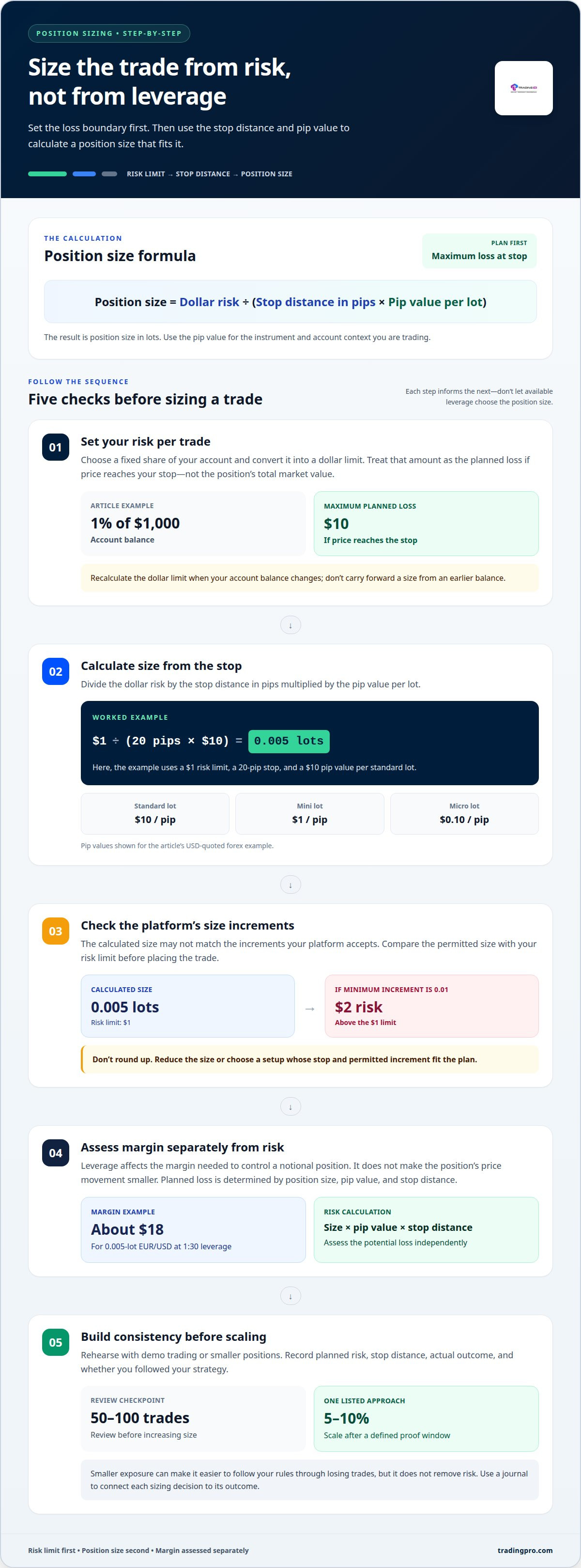
- Set your risk per trade. Choose a fixed share of your account, then convert it into a dollar limit. For example, risking 1% of a $1,000 account means a $10 maximum planned loss. Treat this as the amount at risk if price reaches your stop, not the position’s total market value. A consistent limit gives each trade a clear boundary and helps keep losses from dictating your next decision.
Apply the same calculation before every entry. If your account balance changes, recalculate your dollar risk limit rather than carrying forward a size from an earlier balance. This keeps your risk management aligned with your current capital.
- Calculate position size from the stop. Divide your dollar risk by the stop distance in pips multiplied by pip value per lot. With $1 risk, a 20-pip stop, and a $10 pip value per standard lot, the result is 0.005 standard lots. If the platform only accepts 0.01-lot increments, that trade would risk $2 at the same stop, so it exceeds the $1 limit. Don’t round up; reduce the size or choose a setup whose stop and permitted increment fit your plan.
- Separate leverage from trade risk. Leverage affects the margin needed to control a notional position; it doesn’t make a large position’s price movement smaller. For example, a 0.005-lot EUR/USD position at 1:30 leverage may require about $18 in margin. Calculate the potential loss from position size, pip value, and stop distance, then assess margin separately. This distinction helps prevent available leverage from setting your position size.
- Build consistency before scaling. Use demo trading or smaller positions to rehearse the calculation and record each result. Track planned risk, stop distance, actual outcome, and whether you followed your strategy in a journal. Review at least 50-100 trades before increasing size; one listed approach is to scale by 5-10% after a defined proof window. Smaller exposure can make it easier to follow your rules through losing trades, but it doesn’t remove risk. A journal makes understanding lot size math for rookie traders more systematic by connecting each sizing decision to its outcome.
Once your rules are clear, start setting up your trading account with a deliberate sizing plan.
Choosing lot size based on account balance
Use your account balance to set a dollar risk limit, then size each trade around it. A larger account may support a larger position, but the percentage of capital at risk still matters.
- Convert your risk limit into dollars. A common planning range is 1-2% of account balance per trade. On a $5,000 account, that equals a maximum planned loss of $50 at 1% or $100 at 2%. On a $1,000 account, 1% equals $10. These figures set the loss boundary, not the lot size itself. Your stop distance and the instrument’s value per price move determine how many lots or units fit within that boundary.
Apply the same calculation before every entry. If your account balance changes, recalculate your dollar risk limit rather than carrying forward a size from an earlier balance. This keeps your risk management aligned with your current capital.
- Choose a size that fits a small account. Micro lots are often presented as a starting approach for beginners with account balances from $1,000 to $5,000. Their smaller trade exposure can make it easier to keep a position within a modest dollar limit. Still, a micro lot isn’t automatically low-risk: the stop distance and instrument determine the possible loss.
For a small account, compare your calculated size with the platform’s permitted increments. If the smallest available size would exceed your risk limit, don’t force the trade. Limited sizing options can restrict practical choices, so prioritize controlled exposure rather than expecting extra reward from taking on more risk.
- Plan for drawdowns before seeking compounding. Account losses change the capital available for later trades. After three consecutive losses of 5% each, the example account needs a 17% gain to return to breakeven. That gap shows why a winning trade’s reward doesn’t simply erase an equal percentage loss.
Compounding can also magnify assumptions. An example that compounds 8% monthly for a year reaches roughly 2.5 times its starting capital. Treat that as a mathematical illustration, not a trading forecast. Base lot size on the risk you can tolerate, not on a projected growth curve.
- Review your position size as your balance changes. Recalculate your allowable loss after deposits, withdrawals, gains, or losses. Keep the percentage consistent with your plan, and adjust size only after checking your current balance, stop distance, and the platform’s permitted increment. Don’t increase size just because recent trades were profitable; a short streak doesn’t change how much your account can absorb.
Track your account balance alongside planned risk and actual results. This can help you spot emotional decisions and keep lot size connected to your capital, rather than the excitement of a recent gain.
Standard, mini, micro, and nano lot sizes
For U.S.-regulated forex brokers, minimum trade sizes and lot increments vary by broker, platform, and currency pair. Check the available order-size increment for the specific pair before applying your risk calculation.
-
Distinguish Standard, Mini, Micro, and Nano Lots
Start by matching the lot label to its base-currency units. A standard forex lot represents 100,000 units; a mini lot represents 10,000; a micro lot represents 1,000; and a nano lot represents 100 units.
Each step down reduces the amount of currency controlled by the position. Lot sizes matter because they determine how much a price movement affects your trade. Don’t treat “one lot” as a universal quantity across products or platforms.
-
Relate Lot Sizes to Currency Units and Contracts
Read the contract unit alongside the lot name. The quoted currency, USD, is used to express the exchange rate.
Distinguish currency units from contract counts. Forex lots describe units of the base currency, while other markets may define a lot using contracts, shares, or instrument-specific quantities. These conventions affect exposure, so don’t apply a forex lot assumption to another market.
-
Check Minimum Trade Sizes and Lot-Size Rules
Confirm the smallest order size and permitted increment shown for the pair on your platform. There isn’t one minimum you should assume applies to every U.S.-regulated forex broker and currency pair. An available increment such as 0.01 lot is an example, not a universal rule.
Compare the platform’s smallest permitted position with your calculated trade size. If the available increment would make the position larger than your risk plan allows, don’t increase the size just to place the trade. A smaller unit allows finer sizing when the platform offers it.
- Connect lot size to pip exposure. A nano lot represents 100 units and has a listed pip value of $0.01. That small increment can help illustrate how reducing units changes the dollar effect of a pip. Calculate the value for the actual pair and account currency rather than assuming every pair follows the same conversion.
For comparison, a 30-pip favorable GBP/USD move on a mini lot produces a $30 gain in the stated example. An unfavorable move can create a loss instead. Pair the lot size with a stop loss to understand the planned exposure before entering.
- Use lot labels as a sizing tool, not a promise of profit. A smaller lot changes exposure; it doesn’t make a strategy profitable or remove risk. Record the instrument, unit size, platform increment, and stop-loss distance in your journal.
Review those details before each order. This quick routine can prevent a mistaken lot selection from turning a planned position into a different trade.
Avoiding overleveraging and drawdowns
Leverage can increase market exposure faster than your account balance grows. Protect your plan by separating margin capacity from the potential loss on your position.
- Set position size from planned loss, not available leverage. At 100:1 leverage, a $1,000 margin can control a $100,000 position in the example. That describes buying power, not a safe risk limit. Estimate possible loss using position size, price movement, and stop distance. Then choose a size that keeps the planned loss within your account limit. More leverage doesn’t make the market move less against you.
Calculate margin and trade risk separately. A position may fit within your available margin while still exposing too much of your balance to a small adverse move.
- Keep risk modest while building consistency. A cautious planning range is 0.5%-1% of account balance per trade while developing consistent execution. The right position size still depends on the stop distance and instrument value. If a wider stop increases the planned loss, reduce the position size to keep your risk limit intact.
Discipline matters most after a loss. Don’t increase your size to recover quickly or abandon your stop plan. Those reactions can turn a controlled drawdown into revenge trading.
- Prepare for losing streaks before they happen. A strategy with a 60% win rate can still experience a run of 5-7 losing trades. That sequence doesn’t automatically prove the strategy has stopped working, but it can pressure traders into changing size impulsively.
Write down your maximum risk, entry reason, and stop distance before each trade. Review your records after a streak instead of reacting to a single result. Planned rules give you a consistent basis for judging whether your execution matched your strategy.
- Use a proof window before scaling up. Track performance across 100 trades and use less than 5% drawdown as one example of a proof window before increasing size. Review both outcomes and rule-following. A profitable result with inconsistent execution is a weak basis for taking larger positions.
After reviewing your results, increase size gradually rather than making a sharp jump. Apply the same risk calculation to your current balance, and reduce size if a drawdown changes your planned exposure.
- Compare leverage choices with their risk trade-offs. Oanda reports that traders using 50:1 leverage had 15 times the chance of blowing up their accounts compared with traders using 10:1 leverage. Treat leverage as a risk amplifier, not a target. Lower exposure can leave more room for price movement before a trade reaches its stop.
Build this discipline into your next trading plan. Create your trading account and apply a defined risk limit before sizing each position.
TradingPRO: Rookie Account
TradingPRO’s Rookie Account is a practical next step when you’re ready to apply lot-size calculations to your trading decisions. Use this guide to plan each position: define your account risk, set the stop-loss distance, and calculate a size that fits both.
Focus on process, not speed. A smaller position can make it easier to practise applying your risk rules, while another account tier may better suit your trading approach as it develops. Before placing a trade, understand how the position affects pip value and potential loss.
To discuss whether the Rookie Account fits your next step, contact TradingPRO.
Make Your Next Trade a Deliberate One
Turn understanding lot size math for rookie traders into a repeatable habit: pause before each order, connect the planned position to your trading approach, and follow a defined process instead of reacting to a sudden market move. That discipline can help you trade consistently as your experience develops.
TradingPRO offers Rookie, Micro, and Pro Accounts, giving you options as you shape your trading routine. Choose an account that fits your current approach, and focus on thoughtful execution rather than trading bigger for its own sake.
Contact TradingPRO to discuss your trading and take the next step with a clear plan. Your progress starts with the decisions you make before you place a trade.
Frequently Asked Questions
What are standard, mini, micro, and nano lots, and how many units does each represent?
Forex lot labels describe the base-currency amount: standard is 100,000 units, mini is 10,000, micro is 1,000, and nano is 100. For a EUR/USD trade, those units refer to euros, not dollars. Use the platform’s displayed size and contract details to identify the actual exposure. Lot labels are forex conventions, so don’t assume a “lot” represents the same quantity for stocks, futures, or another instrument.
How does lot size affect profit and loss per pip?
A larger lot makes each pip’s dollar effect larger, in either direction. For example, a standard lot on a USD-quoted pair has a $10 pip value, while a micro lot has a $0.10 pip value. Multiply the pip value by the number of pips gained or lost to estimate the price-move impact. Currency conversion, instrument specifications, and trading costs can affect the final account result.
How do you calculate lot size based on account balance, risk percentage, and stop-loss distance?
First calculate the permitted cash risk: account balance multiplied by the chosen risk percentage. Then divide that amount by the stop distance in pips multiplied by pip value per lot. For example, a $100 account risking 1% sets a $1 risk limit. With a 20-pip stop and a $10 pip value per standard lot, the calculation gives 0.005 standard lots. Round down to an allowed platform increment.
What is the position sizing formula for a beginner forex trader?
Use: position size in lots = dollar risk ÷ (stop-loss distance in pips × pip value per lot). This formula assumes pip value is expressed in your account currency. If it’s quoted in another currency, convert it first. For example, with dollar risk fixed, a wider stop requires a smaller lot size. Check that the result matches the platform’s permitted trade increments.
How do leverage and margin requirements relate to lot size?
Leverage determines the margin required to open a position, while lot size determines exposure to price movements. For a $100,000 position, 10:1 leverage corresponds to 10% margin, or $10,000; 50:1 corresponds to 2%, or $2,000. Lower margin does not reduce the position’s underlying price risk. Calculate potential loss from position size and stop distance separately from the margin needed to open the trade.
What are common lot size mistakes and risks for rookie traders?
Common mistakes include choosing a lot size before setting a stop, confusing margin with the amount at risk, and rounding a calculated size upward. It’s also risky to assume every market uses the same contract units or price increments. Before placing an order, confirm the instrument, size, pip or point value, and stop distance. If the platform’s increments would push exposure above your limit, reduce the trade size or skip the setup.


