


- Published on: 2026-11-06 17:05:02
How to Stop Revenge Trading and Decide When to Trade Again

A loss is not a signal to trade again immediately. To understand revenge trading and how to stop it, start with a firm cooldown: wait at least 15-30 minutes after a loss before deciding whether another trade fits your plan. Revenge trading begins when the urge to recover money takes priority over your rules.
It’s easy to think the next position can make everything right. But trading from frustration can lead to rushed entries, larger positions, or setups you’d normally reject. This guide explains how to recognize revenge trading, identify its emotional triggers, and set a practical pause rule for your next session. You’ll also learn how to judge whether you’re ready to trade again or whether the best move is to stop for the day.
Key Takeaways
- Set a loss-count limit and a daily maximum-loss rule before trading, so frustration doesn’t decide when the session ends.
- Spot warning signs such as rushed re-entries, more trades than usual, or increasing position size after a loss.
- Understand how the urge to recover a loss can distort risk decisions, even for experienced traders.
- Use a defined pause and a simple reset routine to regain perspective before considering another trade.
- Review your trading patterns to identify the situations that trigger impulsive decisions and strengthen your rules around them.
How long should I stop trading after a loss?
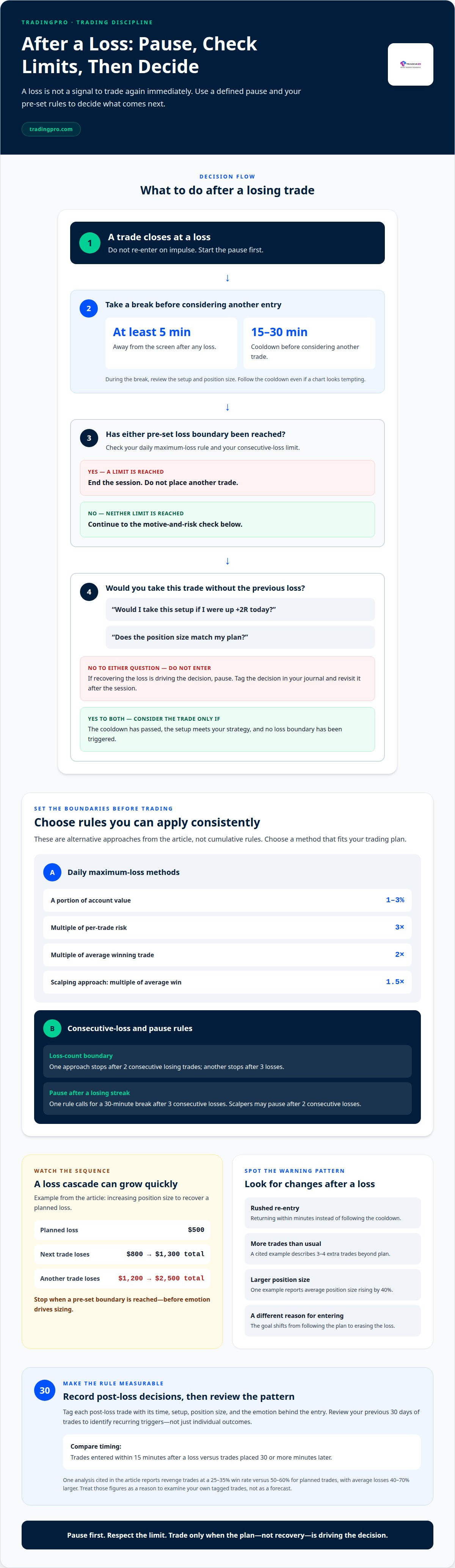
Pause before re-entering: take at least 5 minutes away from the screen, then use a 15-30-minute cooldown before considering another trade. Set loss limits in advance, so a losing position doesn’t rewrite your strategy.
-
Set Daily and Consecutive-Loss Limits
Choose a daily maximum loss and a consecutive-loss limit before trading. One approach is stopping after 2 consecutive losing trades; another rule stops after 3 losses. Treat these as alternative boundaries, not targets to reach. A daily limit creates a firm ceiling, while a loss-count limit blocks another trade after a difficult sequence.
-
Track Losses and Pause Before a Cascade
Record each loss against both limits, then stop when either boundary is reached. A cascade can begin when a trader increases position size to recover a planned $500 loss. In one example, the next trade loses $800, bringing the total to $1,300; another loses $1,200, raising it to $2,500. Stop the sequence before emotion drives sizing.
-
Recognize Loss Aversion and Break-Even Effects
Name the urge to get back to break-even before acting on it. Kahneman and Tversky’s prospect theory describes losses as feeling roughly twice as intense as equivalent gains. A 2024 meta-analysis reported an average loss-aversion coefficient of 1.955 across 607 estimates. That emotional effect can make recovering a loss feel more urgent than following a strategy.
- Define your daily maximum in a way you can apply consistently. A common range is 1-3% of account value; another example sets the limit at three times per-trade risk. Some guidance uses 2x the average winning trade, while a scalping approach uses 1.5x average win. These are different methods, not cumulative rules. Select one that fits your trading plan.
- Make the pause rule specific to your trading style. After 3 consecutive losses, one rule calls for a 30-minute break; scalpers may pause after 2 consecutive losses. Take at least 5 minutes away from the screen after any loss, and allow 15-30 minutes before another entry. During the break, review the setup and position size. If a limit has triggered, end the session.
What Is Revenge Trading?
Revenge trading means taking a position to recover a loss rather than because the next setup meets your strategy. To understand revenge trading and how to stop it, track what changes after a losing trade: your position size, trading pace, and reasons for entering.
- Compare each decision after a loss with your usual rules. Research by Coval and Shumway on proprietary traders at the Chicago Board of Trade described increased afternoon risk-taking after morning losses. The warning sign isn’t simply trading again; it’s changing your risk to win back money. If you wouldn’t take the next trade on a profitable day, pause and reassess.
- Tag post-loss trades and record the time, setup, position size, and emotion behind each entry. A journal makes patterns visible: for example, you may re-enter within minutes, trade more often during an hour, or double or triple your usual position. Review your previous 30 days of trades to identify recurring triggers, not just individual outcomes. This record also helps turn revenge trading and how to stop it into a specific review, rather than a vague intention.
- Set a cooldown after a losing trade and follow it before placing another order. A 15-minute pause is one example; compare results for trades entered within 15 minutes against trades placed 30 or more minutes later. The gap between trades gives you a measurable way to test whether urgency affects your decisions. Follow the rule even when a chart appears tempting.
- Use platform controls to put space between an emotional impulse and an order. Where available, set alerts for loss thresholds, order-size limits, or a timed break. Otherwise, start a timer and close the order ticket during your pause. These tools can support your rules, but they can’t determine whether a setup fits your strategy.
- Ask two questions before the next trade: “Would I take this setup if I were up +2R today?” and “Does the position size match my plan?” If either answer reveals recovery is the real motive, don’t enter. Tag the decision in your journal and revisit it after the session. This turns trading psychology into a repeatable review process.
- Review outcomes without judging a trade by profit alone. One analysis reports revenge trades at a 25-35% win rate, compared with 50-60% for planned trades, and average losses 40-70% larger. Treat those figures as a reason to examine your own tagged trades, not as a forecast. To put a structured trading routine into practice, you can create a trading account.
Definition and common signs of revenge trading
Look for a pattern, not just one losing trade, to identify revenge trading. The warning appears when recovering a loss takes priority over your planned setup and risk rules.
-
Define Revenge Trading and Its Causes
After a loss, start by checking why you want to enter again. Revenge trading means placing a trade mainly to win back money, rather than because your strategy signals an entry. Frustration, urgency, and regret can narrow your thinking. For example, you might abandon a planned setup for a weaker position simply to feel back in control.
-
Identify Common Signs
Compare your behavior after a losing trade with your usual session. Re-entering within minutes, taking more trades in an hour than usual, or increasing position size can signal that emotion is steering the decision. One example describes traders taking 3-4 extra trades beyond their plan, with average position size rising by 40%. Treat these changes as prompts to pause and review.
- Notice when your goal shifts from following your plan to erasing a loss. A revenge trade may seem to have a technical rationale, but its timing or size can reveal another motive. Ask yourself whether you’d take the same position if your previous trade had been profitable. If not, you may be focused on recovering money rather than evaluating the current setup.
- Look for repetition across sessions, not just a single impulsive entry. One example describes 10 revenge-trading sessions in a month, roughly twice a week. Mark the conditions that came before each episode, such as a losing position or pressure to recover before ending the session. A recurring pattern gives you a practical signal to strengthen your discipline at that point.
- Distinguish a valid strategy change from an emotional reaction. A planned adjustment has a clear reason tied to market conditions or tested rules. An impulsive change often follows a loss and increases exposure without a setup-based explanation. For instance, moving a stop farther away after entry can turn a controlled decision into an attempt to avoid accepting the loss.
- Review the full sequence before labeling a trade. Record your original plan, what changed after the loss, and whether the next position followed your rules. A single fast entry may have a legitimate setup; repeated departures from your discipline over a session are stronger evidence of a problem. Use your review to identify when recovery-focused thinking first replaced your strategy.
Dopamine withdrawal and emotional reactions to losses
After a loss, urgency can feel like a reason to act, but it’s a cue to pause. A short reset can help you separate your emotional reaction from your next decision.
Understand Emotional Reactions to Losses
Name the feeling before considering another entry. “Dopamine withdrawal” is sometimes used informally to describe the letdown when an expected reward doesn’t arrive; it isn’t a diagnosis. A losing trade can still bring frustration, disappointment, or an urge to restore your balance. Treat these reactions as signals to slow down, not instructions to trade.
- Pause before acting when you feel pulled toward an immediate entry. Spend 15 seconds naming the emotion, then stand and step away from the screen for 30 seconds. Naming the feeling creates a pause between the loss and your response.
- Use the remaining reset time to settle your attention. For 90 seconds, repeat box breathing four times: inhale for four seconds, hold for four, exhale for four, then hold for four. Four rounds take 1.5 minutes. Return to the chart only after completing the sequence, not midway through an impulsive order.
- Allow time for the reaction to ease before judging the setup. Cortisol after a loss takes roughly 20-30 minutes to return to baseline. A brief pause won’t erase a loss, but it can give you space to assess whether an entry still matches your rules.
Identify Emotional Triggers and Willpower
Record what triggered the urge to trade. Common examples include frustration after a stopped-out position, embarrassment about a mistake, or fear that the market will move without you. A journal entry can connect an emotion with a specific action, such as entering early or choosing a larger position than planned.
- After each loss, write one sentence: “I feel ___, and I want to ___.” For example: “I feel frustrated, and I want to recover the loss immediately.” This turns a vague reaction into a pattern you can recognize before placing another order.
- Set a rule for your trigger instead of relying on willpower alone. If frustration leads to rushed entries, complete a three-minute reset before opening an order ticket. If fear of missing out prompts you to take larger positions, stick to your planned size and reject entries that break your rules.
- After the session, review your journal and note which trigger produced the strongest urge. Track whether it led to an unplanned entry, a larger position, or no trade. Comparing those outcomes helps you refine your response based on actual decisions, not memory alone.
Recognizing revenge-trading behaviors
Catch the shift from planned trading to recovery-driven decisions. One impulsive entry can be a mistake; repeated changes to your rules, rushed timing, or increased risk deserve attention.
- Compare each session with your usual baseline. Record how many trades you typically take, how long you wait between entries, and your usual position size. For example, a fast re-entry after a loss is more concerning if your normal strategy requires careful setup review. A clear baseline helps you distinguish ordinary variation from behavior driven by frustration.
- Mark the moment your plan changes. Note whether you moved a stop, entered before confirmation, or chose a setup you would usually reject. An emotional trade can lose -1.5R to -3R when you widen a stop, hold past it, or increase position size. The key signal is the rule change, not whether that trade happens to win.
- Tag questionable entries in your journal, then review them together. Compare the reason for entry, position size, time since the previous trade, and outcome. If several tagged trades share a trigger, such as trying to recover a loss, you have a pattern to address. Don’t judge the decision by profit alone.
- Use a pre-entry test to separate strategy from urgency. Ask whether the setup still qualifies as an A+ entry and whether you would take it while up +2R. If no such setup appears within 30 minutes after a loss, one rule is to stop for the session. That boundary prevents waiting at the screen from becoming pressure to enter.
- Check whether the market context, rather than your mood, supports another trade. Major economic data releases and central bank decisions can increase volatility and affect whether a familiar setup still fits your plan. Write down the specific market condition you’re responding to. “I need to make it back” describes a motive, not a market signal.
- Turn each warning sign into a written response before your next session. A practical way to stop revenge trading is to set an if-then rule: if an unplanned urge follows a loss, close the order ticket and review your plan. Track whether you followed the rule, not just whether you recovered money. This makes your trading behavior easier to assess and gives discipline a repeatable action.
Build your next session around deliberate entries and defined rules. To make progress on revenge trading and how to stop it, put your plan into practice with a trading account.
TradingPRO: Social Trading / Copy Trading
TradingPRO offers Social Trading / Copy Trading for traders who want to follow and replicate other traders’ strategies. It provides a structured way to observe trading decisions, but copying doesn’t replace your own risk limits or pause rules. Keep your loss thresholds in place and assess whether a copied approach fits your goals and risk tolerance.
If losses are driving rushed decisions, step back before deciding how to trade next. Review your limits first, then consider whether Social Trading / Copy Trading fits your approach. Contact TradingPRO to discuss its trading options.
Make your next trading decision deliberate
Build your next session around one clear commitment: follow your written plan, even when a loss makes another entry feel urgent. Learning how to stop revenge trading starts with treating discipline as part of your trading edge, not something to rely on only when markets are calm. Set your rules before the session, then use them to decide whether an opportunity deserves your attention.
Your account should also fit the way you intend to trade. TradingPRO offers Rookie, Micro, and Pro Accounts to consider as you shape your approach. Choose deliberately, and keep risk decisions separate from any desire to recover a loss.
If you’re ready to take a measured next step, connect with TradingPRO and explore the available account options. Keep your plan in control, and move forward with focus.
Frequently Asked Questions
How to stay disciplined when trading?
Turn your plan into a short checklist to complete before every order. Confirm the setup, reason for entry, exit condition, and position size. If you can’t explain in one sentence why the trade fits your rules, don’t place it yet. Keep the checklist beside your charts and record any deviation afterward. Review your notes outside the session, when live price movements aren’t competing for your attention.
Should I change my strategy after a losing streak?
Don’t change your strategy solely because recent trades lost. First, check whether you followed it correctly. Separate execution errors from a strategy that may no longer fit current market conditions. For example, review whether your entries met your criteria and your exits followed your plan. If your process was consistent, assess the strategy using your broader records before making changes. Avoid revising rules during an active session, when frustration can make short-term results feel decisive.
Why do traders revenge trade after a loss?
Traders may revenge trade because a loss creates an immediate urge to regain money, restore confidence, or feel in control again. That urge can make another entry seem like a solution, even when the setup is weak. For example, you might open a position simply because the market is moving, not because your plan signals an opportunity. Naming the motive before acting helps separate recovery-focused thinking from a deliberate trading decision.
What is revenge trading in investing?
Revenge trading in investing means making a new trade mainly to compensate for a previous loss, rather than following a reasoned plan. It can mean switching direction, entering without a clear setup, or increasing exposure because the earlier result feels unacceptable. This differs from a planned portfolio adjustment based on a considered change in goals or market assumptions. The motive and decision process matter more than whether the new position eventually makes money.
What causes revenge trading after a loss?
Revenge trading can follow frustration, regret, fear of missing a market move, or pressure to prove a decision was right. A trader may also treat a loss as a personal failure instead of one outcome within a broader process. For instance, after exiting at a stop, they might re-enter immediately to avoid feeling they missed a reversal. Identifying the emotion and situation that came before the urge can reveal your personal trigger.
What are common signs of revenge trading?
Common signs include entering without your usual confirmation, changing an exit plan mid-trade, or choosing a position for emotional reasons. Watch for thoughts like “I have to make this back” or “I can’t finish the session down.” One unusual choice doesn’t establish a pattern. Compare the decision with your written rules and usual routine. Repeated departures after losses are a stronger cue to stop and review.
How does revenge trading affect trading performance and risk?
Revenge trading can undermine performance by replacing selective entries with decisions driven by urgency. It may also increase exposure if you add positions, hold trades beyond your exit conditions, or take setups outside your plan. For example, an unplanned position can overlap with existing market risk and leave your account more exposed than intended. Track both the reason for each trade and your total open exposure, not just whether individual positions close profitably.
What rules can help prevent revenge trading?
Use written rules to define when you may enter, what invalidates a setup, and when your session ends. Add an if-then response for your main trigger: “If I want to trade to recover a loss, then I close the order screen and review my plan.” Keep the rule simple enough to follow under pressure. A journal can show whether the response is working and which situations need a firmer boundary.


