


- Published on: 2026-11-02 07:33:57
How to Fund a Trading Account and Compare Deposit Options

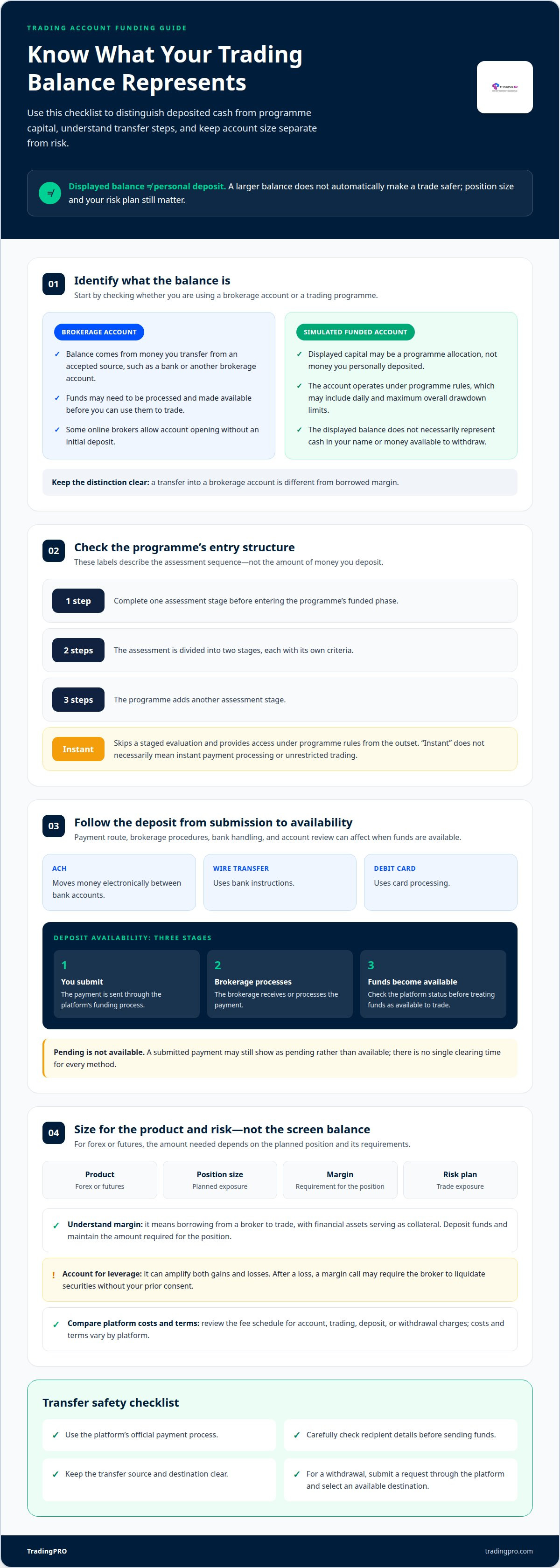
Your trading balance may be money you deposited or capital displayed in a simulated funded account. To understand how to fund a trading account, first distinguish between the two: a brokerage account is funded by transferring money from a bank or another brokerage account, while a simulated funded account operates under programme rules.
It’s easy to focus on the balance displayed on screen. But where that balance comes from affects what it represents, how losses are handled, and how much you can risk. A larger balance does not automatically make a trade safer. Position size and your risk plan still matter.
This guide explains the difference between brokerage deposits and simulated funded capital, compares common transfer methods, and shows how account size relates to risk. Use it to choose an account setup that fits your trading approach without mistaking a displayed balance for cash you deposited yourself.
Key Takeaways
- Some online brokers let you open an account without an initial deposit, so compare account requirements before moving money.
- ACH, wire, and debit deposits can differ in processing and clearing; the payment method and platform procedures affect when funds are available.
- For forex or futures, choose an account size and funding approach that fit your trading plan, rather than treating a displayed balance as a measure of safe risk.
- Protect transfers by using the platform’s official payment process and carefully checking recipient details before sending funds.
- TradingPRO’s Rookie Account is one account option to consider when choosing a trading environment that aligns with your experience and approach.
What Is a Funded Trading Account?
A funded trading account can mean either a brokerage account holding your deposited money or an account provided through a trading programme. The distinction matters before you place a trade. A brokerage balance comes from funds you transfer, while a simulated funded account may display capital you did not deposit. The balance on screen does not always represent cash in your name or money available to withdraw. Understanding how to fund a trading account starts with identifying which type of balance you’re using.
For a brokerage account, funding means transferring money from an accepted source before trading. Common sources include a checking or savings account, or another brokerage account. For example, you might transfer cash from your bank to a brokerage account, then use the available balance to place trades. The payment method affects how the transfer is processed, while the brokerage’s procedures determine when funds can be used. Keep the source and destination clear: a transfer into your account is different from borrowed margin.
A prop-firm programme works differently. Rather than depositing trading capital into a brokerage account, a trader may complete an evaluation against firm-defined rules. These may include daily and maximum overall drawdown limits. A funded account balance represents the programme’s stated trading allocation, not necessarily a personal deposit. Understanding how to fund a trading account means distinguishing personal deposits from programme capital.
Evaluation structures vary. In a one-step model, the trader completes one assessment stage before entering the programme’s funded phase. A two-step model divides the assessment into two stages, each with its own criteria. A three-step programme adds another stage. These labels describe the evaluation sequence, not the amount of personal money deposited. An instant-funding model skips a staged evaluation and provides access under programme rules from the outset. “Instant” describes the model, not necessarily payment processing or unrestricted trading.
Compare each model by what its balance represents and what must happen before trading under programme terms. A brokerage account generally requires a transfer from a bank or another brokerage account, although some online brokers allow account opening without an initial deposit. A prop evaluation focuses on meeting set trading criteria, while instant, one-step, two-step, and three-step options differ in entry structure. Before choosing, distinguish deposited cash from simulated capital, understand applicable drawdown rules, and match the structure to your strategy. That’s a practical starting point when deciding how to fund a trading account.
Brokerage account initial deposits
To decide how to fund a trading account, open the brokerage account and review its deposit options. For a withdrawal later, submit a request through the platform and select an available destination.
Deposit Clearing Times
Deposit clearing is the process of moving a payment from submitted to available funds. ACH, wire transfer, and debit card payments follow different paths, so check the platform’s status when planning a trade. ACH connects bank accounts, a wire uses bank instructions, and a debit card deposit uses card processing. A submitted payment may still show as pending rather than available.
Opening an account and making a deposit can be separate decisions. Some online brokers allow customers to open an account without an initial deposit. If you’re deciding how to fund a trading account, start in the account’s funding area, choose an accepted method, enter the amount, and review the destination details before submitting.
Margin Funding and Initial Requirements
Margin funding means borrowing money from a broker to trade, with financial assets serving as collateral for the loan. To meet an initial margin requirement, deposit funds and maintain the amount required for the position. The margin requirement affects how much of your balance is committed, so consider it when sizing a trade. Leverage can amplify gains and losses. After a loss, a margin call may require the broker to liquidate securities without your prior consent.
Forex and Futures Funding
For forex or futures, fund the relevant brokerage account through an accepted payment method, then assess the margin required for planned positions. The amount needed depends on the product, position size, margin requirement, and risk plan. A useful way to approach how to fund a trading account is to estimate each intended trade’s exposure before choosing a deposit amount. Don’t treat a displayed balance as a risk limit.
Brokerage accounts and prop-firm programmes handle capital differently. Deposited brokerage funds are distinct from a programme balance governed by firm rules. Compare the account type, payment process, and applicable requirements before committing money. Review the brokerage’s fee schedule for account, trading, deposit, or withdrawal charges, since costs and terms vary by platform.
After you’ve compared the funding process and risk requirements, you can begin account registration.
How long do ACH, wire, and debit deposits take to clear?
There is no single clearing time for every ACH, wire, and debit card deposit. The payment route, brokerage processing, bank handling, and account review all affect when a deposit becomes available. Separate the process into three stages: you submit the payment, the brokerage receives or processes it, and the platform makes the funds available for trading. A pending deposit is not the same as an available balance.
ACH transfers move money electronically between bank accounts. For example, you might connect a checking account to your brokerage platform and request a deposit through the account’s funding screen. The bank and brokerage each process part of the transfer, so the submission time does not necessarily indicate when the balance is ready to trade. Check whether the platform labels the transaction pending, processing, or available.
Wire transfers are initiated through a bank and sent to the brokerage’s receiving details. The process involves more steps than choosing a saved bank connection: enter the brokerage’s wire instructions, submit the payment through your bank, and allow the receiving account to match it to your brokerage profile. An incorrect reference or recipient detail can complicate identification, even if the bank has sent the funds.
Debit card deposits begin with a card payment rather than a bank transfer request. Add the deposit through the platform’s payment screen, select the card, and review the amount before submitting. Card authorization and brokerage availability are separate events. A payment accepted by the card provider can still show as pending on the trading platform.
To understand a payment’s status, review the transaction history in your brokerage account. Match the payment method, amount, submission date, and status shown on screen. If your bank statement records a completed payment while the platform still shows a pending deposit, the records reflect different processing stages. Keep the confirmation details so you can identify the transfer accurately.
- For ACH, review the connected bank account and the brokerage’s displayed deposit status.
- For a wire, compare the bank confirmation with the brokerage’s receiving details.
- For a debit card, distinguish payment authorization from funds available to trade.
Plan around when funds become available, not the moment you press “submit.” If a trade depends on a specific balance, confirm that the platform shows the money as available before placing the order. This helps prevent a pending ACH transfer, wire, or card payment from being mistaken for funds available to trade. Check the brokerage’s deposit screen for method-specific instructions and status updates.
How to fund a forex or futures trading account, and how much is needed?
Funding a forex or futures brokerage account starts with the account’s accepted payment methods and trading requirements. Open the relevant account, choose a payment source, enter the amount, and submit the transfer through the platform. Then distinguish the deposited balance from the funds available for a particular position. The amount needed depends on the product, position size, margin requirement, and the risk you plan to take.
Before sending money, identify the account type and payment route. A bank transfer from checking or savings can move funds into a brokerage account, and another brokerage account may also be a source. Follow the platform’s receiving instructions, enter the account details carefully, and review the amount before submitting. If the transfer comes from another person, a transfer-related option may apply when that person has the same last name as the individual account holder. A spouse or child are examples.
Set your planned amount based on the trade, not an attractive account balance. For a forex position, consider the currency pair, position size, margin requirement, and how much of the account could be exposed to a loss. For futures, consider the contract and the margin required to hold the position. These factors determine how much available capital a trade uses. A deposit that covers the initial requirement may still leave little room for losses or other account costs.
- Choose the forex or futures account that matches the product you intend to trade.
- Review its payment options and trading requirements on the platform.
- Set the deposit around your intended position size and risk plan.
- Check the displayed available balance before placing a trade.
Prop-firm funded balances differ from brokerage deposits. A funded programme may also apply firm-defined rules, including daily and overall drawdown limits. Compare those rules with your strategy before treating a stated balance as usable risk capital.
For either market, don’t choose an amount solely because it is the platform’s minimum or because a larger balance seems more powerful. Match the deposit to the margin needed for planned positions, the losses your plan can absorb, and your ability to manage that exposure. This gives you a clearer funding target before your first forex or futures order.
What risks and scams should I watch for when transferring money to a trading platform
A transfer can go wrong through a fake payment page, a misdirected bank transfer, or someone impersonating platform support. Before sending money, open the trading platform directly and use its own funding screen. Compare the recipient name and payment instructions there with the details entered in your bank or card payment. Treat a message supplying new account details without warning as a reason for extra scrutiny.
Phishing messages often imitate a brokerage, bank, or support team. For example, an email may claim your account will be restricted unless you deposit immediately through its link. Don’t use payment links in unexpected messages. Instead, open the platform through your usual sign-in route and review account alerts there. Treat requests for passwords, one-time codes, or remote access as warning signs, not funding steps.
Payment redirection can happen when someone sends altered wire instructions or asks you to pay an individual account. Compare every wire detail with the instructions shown inside your brokerage account. Check the recipient, account reference, and payment amount before authorizing the transfer. For ACH or debit deposits, start inside the platform and avoid entering card or bank details on a page opened through an unsolicited text.
Pressure is another warning sign. A caller claiming to represent a trading platform might demand an extra payment to release a withdrawal or prevent account closure. Pause before transferring money. Review the account’s transaction history and contact details through the platform itself, rather than replying to the caller. Keep bank confirmations, card receipts, and platform notifications together so you can compare the payment trail.
- Use the platform’s own funding screen to begin a deposit.
- Match recipient and account details before submitting a bank payment.
- Reject requests for passwords, one-time codes, or remote access.
- Save transaction records and compare them with the platform balance.
After a transfer, compare the amount on your bank or card record with the transaction shown in the platform. If the amounts or recipient details differ, don’t send a second payment to “correct” the first. Keep the message, receipt, and transaction reference. Use the platform’s account controls and your bank’s official channels to report a suspected unauthorized payment. A clear record helps identify which step needs attention.
Keep the same discipline when exploring a new trading account: use the official registration route and follow its account setup process. Register for a trading account.
TradingPRO: Rookie Account
TradingPRO’s Rookie Account is an option to consider when choosing a starting point for your trading approach. Use the distinctions in this guide to separate brokerage deposits from programme balances, then consider which account tier fits your experience and intended style.
The Rookie Account is one option alongside the Micro Account, Pro Account, and Scalp Account. Compare these account choices with the markets and strategies you plan to pursue, and keep your risk approach central to the decision. The right account type should support your trading plan, not replace it.
Visit tradingpro.com to explore the Rookie Account and other account options.
Set Your Funding Plan in Motion
Before making a deposit, decide what role the account should play in your trading routine. Choose a funding method you can track, set a personal limit for the amount committed, and keep trading capital separate from money needed for everyday expenses. A clear plan for how to fund a trading account makes the transfer one part of a broader process, not a shortcut to larger positions.
Use your next step to align your account choice, payment method, and risk approach. TradingPRO offers Rookie, Micro, and Pro Accounts to consider as you shape your trading setup. Take time to choose an approach that fits your goals and how you intend to trade.
Explore account options and begin registration, then move forward with a focused plan and deliberate decisions.
Frequently Asked Questions
How do I deposit money into a brokerage trading account?
Start a deposit from the brokerage platform, select an available payment method, and enter the amount. For example, choose a linked checking account, then review the destination account and transfer details before submitting. Keep the confirmation record so you can match the payment to the brokerage transaction later. A pending status means the platform has not yet marked the funds available for trading, so use the displayed balance status when planning an order.
What funding methods do U.S. brokerage firms accept?
Accepted methods depend on the brokerage, but common options include ACH transfers, wire transfers, and debit card payments. A bank transfer can draw from checking or savings, while another brokerage account can also provide funds. For example, a trader moving cash from an existing brokerage should select the receiving account shown on the new platform. The available choices appear in the account’s deposit process and determine which details you enter.
Are there fees or minimum deposits to fund a trading account?
Fees and minimums depend on the brokerage’s account terms and payment route. Some online brokers allow customers to open an account without an initial deposit, separating account opening from funding. Before transferring money, review the platform’s fee schedule for deposit, withdrawal, account, or trading charges. Mutual fund fees are a separate consideration: they can be complex and affect investment performance, so include them when assessing a fund purchase.
What are brokerage account funding limits and deposit rules in the U.S.?
Funding limits and account rules are set by the brokerage and selected payment method, not by one universal deposit amount. The platform’s deposit process shows how much it will accept for that transaction. For example, a bank transfer and card payment may follow different account procedures. Keep the account holder and payment source details aligned, and distinguish a transfer limit from trading requirements such as margin.
Can I fund a trading account with a credit card, check, or cryptocurrency?
Use a credit card, check, or cryptocurrency only when the brokerage lists that method among its funding options. Debit card deposits are different from credit card payments, so don’t assume one implies the other. Checks also require specific handling instructions, while cryptocurrency transfers involve a separate asset and wallet process. A brokerage deposit is not the same as cryptocurrency wallet service; the platform’s funding process defines the supported routes.


