


- Published on: 2026-10-21 12:31:06
How to Become a Signal Provider and Attract Copiers

Consistency earns credibility before bold performance claims do. To understand how to become a signal provider, build at least 3 months of real trading history, document your strategy and risk controls, then apply through a platform that supports copy trading. A clear, verifiable record gives potential copiers a basis for assessing how you trade.
It’s natural to focus on finding followers, but attracting copiers starts with showing how your strategy performs through both gains and losses. Be transparent about position sizing, drawdowns, and performance, and never present past results as a promise of future returns.
This guide covers the practical steps: eligibility, building a live track record, presenting your profile to attract copiers, and understanding profit sharing and High Water Marks. Learn how to build trust through disciplined reporting, explain your approach clearly, and help copiers make an informed decision.
Key Takeaways
- Set clear position-sizing rules, such as risking 1% of equity, and make drawdown visible so copiers can assess your approach.
- Build a profile around transparent performance and a consistent strategy; claims of unusually high returns can undermine trust.
- Use a free trial or a limited sample of signals to introduce your approach and gather useful feedback from potential copiers.
- Understand how profit sharing and High Water Marks affect when performance fees are calculated and what happens after a loss.
- Match your trading style to an account environment, then choose the next step that supports your copy-trading goals.
What are the requirements to become a signal provider?
Start with a trading record, a defined strategy, and clear risk controls. A strong provider profile shows how you manage trades, not just whether they end in profit.
-
Review provider responsibilities
Document your strategy, position-sizing rules, and the risks copiers take when following your trades. For example, say whether you use short-term entries or hold positions longer, and explain how you manage losing trades. Keep published signal details aligned with your actual trading. Use the signal data form to enable or disable a signal when you need to stop sharing it.
-
Set risk and drawdown limits
Choose a risk-per-trade rule before publishing, then apply it consistently across your trading. A guideline such as risking 1% of equity gives copiers a clear reference point for position sizing. Treat maximum drawdown as a core profile measure: a level under 20-30% is a strong indicator. Avoid increasing trade size to recover losses, since that can deepen a drawdown.
-
Apply profile and risk-management tips
Build your profile around specific, verifiable details: instruments traded, strategy, holding style, and risk controls. Explain what copiers can expect from your approach without promising future returns. Compare your published profile with your recent trades before allowing copiers to follow. Correct outdated details, and disable the signal if its stated strategy no longer reflects your trading.
- Choose a platform that supports providers. Register through a broker or social-trading platform with a signal-provider feature and a process for publishing trade activity. Before registering, prepare your strategy description, trading history, and risk rules. Eligibility and profile tools vary by platform.
Copy trading lets copiers replicate trades in their own accounts. Paid signals provide trade ideas for subscribers to act on themselves. Investment advisory services involve recommendations tailored to an individual’s circumstances, so the service structure and audience matter.
- Define your U.S. service before launch. Whether a provider needs registration or a license depends on the activity, compensation, and assets involved. Copying trades, selling general signals, and giving individualized investment advice are distinct service models. Set out exactly what you will provide and how you will be paid, then seek U.S. legal guidance on the rules that apply to that model.
How do I attract Copiers as a Signal Provider?
Attracting copiers takes more than strong returns: people need clear evidence, understandable risks, and an easy way to assess your approach. Use these steps to make your profile more useful to potential followers across markets and time zones.
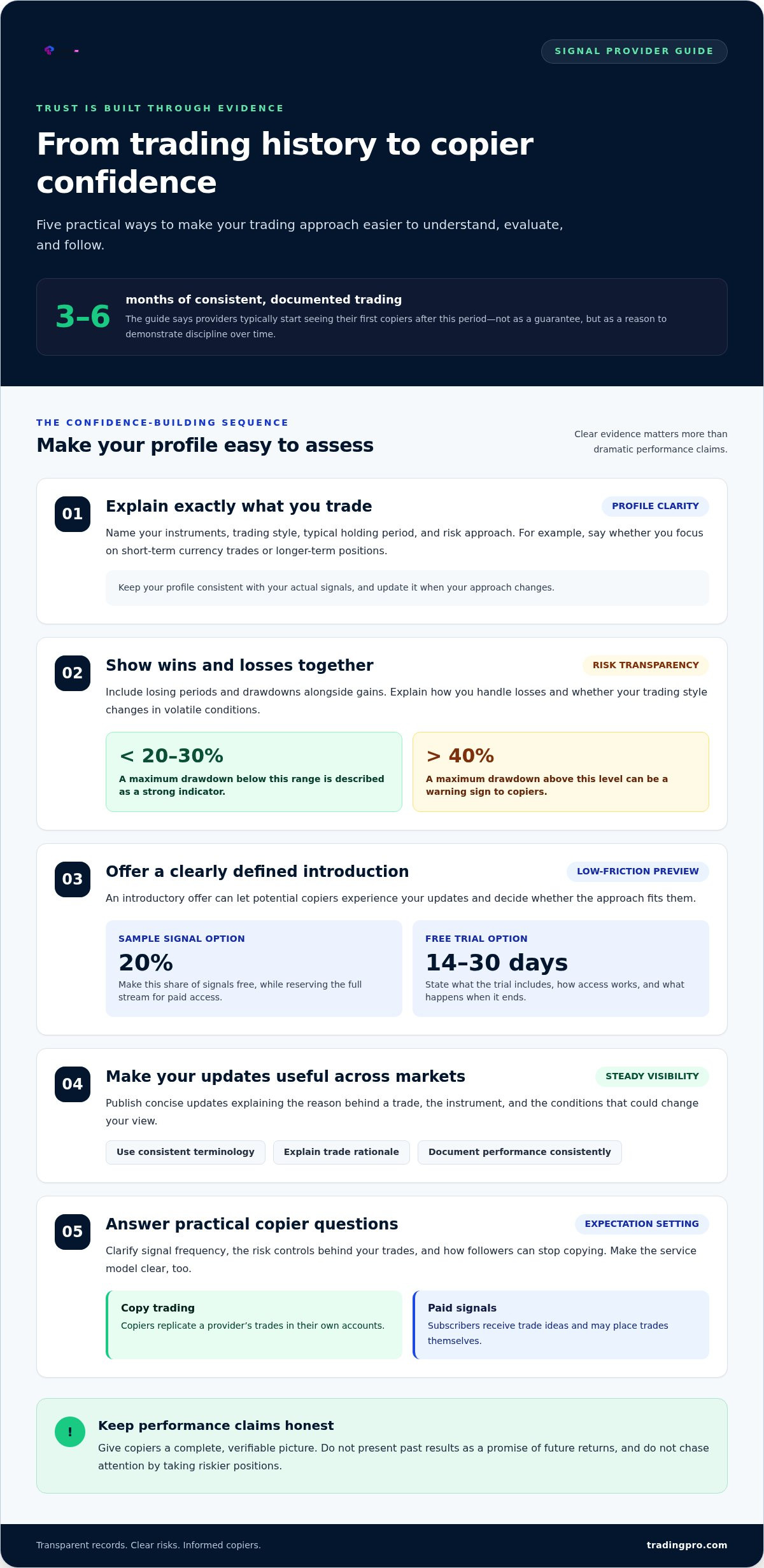
- Make your profile easy to evaluate. Describe your instruments, trading style, typical holding period, and risk approach in direct language. Give a concrete example, such as whether your strategy focuses on short-term currency trades or longer-term positions. Copiers need to understand what they’re following before they choose to copy. Keep profile details consistent with your actual signals, and update them when your approach changes.
- Show a complete picture of performance. Include losing periods and drawdowns alongside gains, so visitors can assess the pattern rather than one standout trade. A maximum drawdown above 40% can be a warning sign for copiers reviewing a provider. Explain how you handle losses and whether your trading style changes during volatile conditions. Avoid dramatic return promises; transparent context gives potential followers a more useful basis for comparison.
- Use an introductory offer with a clear boundary. One approach is to make 20% of your signals free, while reserving the full signal stream for paid access. A free trial lasting 14-30 days can also help initial subscribers experience your updates and share feedback. State what the trial includes, how access works, and what happens when it ends. Don’t leave prospective copiers guessing about the difference between sample signals and full access.
- Build visibility steadily across regions. Publish concise updates that explain the rationale behind a trade, including the instrument and the conditions that would change your view. Use consistent terminology so international copiers can follow your method without relying on slang. Providers typically start seeing their first copiers after 3-6 months of consistent, documented trading. Treat that period as a chance to demonstrate discipline, not a reason to chase attention with riskier positions.
- Answer copier questions before they become objections. Clarify how often signals appear, what risk controls guide your trades, and how followers can stop copying. Explain that copy trading mirrors a provider’s activity, while paid signals may require subscribers to place trades themselves. A useful FAQ makes those differences visible. If you’re preparing to explore a copy-trading account, you can start the registration process as your next practical step.
Building a live performance track record
Build a record that lets traders assess consistency, exposure, and earnings potential across different market conditions. Separate demo testing from live-account results, and report each clearly.
Signal-provider charges can follow a subscription or performance-fee model. Platform deductions depend on its fee structure, while your published terms should explain how charges and payouts work.
- Forward-test the strategy before promoting it. Run an intraday system on a live demo account for typically 3-6 months, recording each entry, exit, and rule change. Label demo results accurately; don’t blend them with live trading-account performance. This testing period can reveal whether execution matches the strategy and whether leverage magnifies losses beyond your plan.
- Keep the record running through different conditions. A track record of six months or more can make a provider profile more attractive by showing performance over a longer period. Log results consistently, including flat or losing periods. A short winning streak gives traders less information about how your strategy behaves when market conditions shift.
- Measure consistency, not just headline returns. Track monthly return variance and aim to keep it under 20% monthly. Compare each month with your strategy’s stated approach, then explain material changes in exposure or execution. A stable pattern helps readers interpret earnings without mistaking one unusually strong period for the whole record.
- Report performance analytics together. A profit factor above 1.5 is a strong profile indicator; below 1.0 is a warning sign for copiers. Pair that measure with win rate and average payoff, since a win rate above 55% or a strong payoff ratio can support a profile. Show losses and gains in context, not as isolated highlights.
- Set fee and payout terms before accepting followers. State whether earnings come from subscriptions or a share of copier profits, and explain the calculation period, settlement process, and treatment of losses. Don’t present gross returns as provider income: actual payouts depend on the stated fee model and eligible results. Keep the terms visible so traders understand what they pay and when charges apply.
Profit-sharing settlements and High Water Marks
A signal provider shares trading decisions so other accounts can replicate the strategy, often in exchange for a commission. Set the sharing ratio and settlement rules clearly before inviting copiers.
- Choose how you’ll share the strategy. Decide whether copiers will replicate signals automatically in real time or follow trade ideas themselves. Explain what each signal includes, such as the instrument, direction, and entry or exit instruction. Keep the published strategy consistent with your trades. When registering a signal, specify the account’s investor password, not its master password.
- Set a profit-sharing ratio copiers can understand. A starting ratio of around 20-30% can help attract initial followers. State whether the percentage applies to eligible profits, how often settlement occurs, and how losses affect later calculations. Keep the terms visible before copiers connect their accounts. Clear rules help each follower understand how provider earnings relate to their own results.
- Explain the High Water Mark before settlement. A High Water Mark tracks the account’s previous peak value. After a loss, the account must recover above that peak before a performance fee is charged on new gains. This prevents charging a performance fee twice on the same recovered value. Explain how the platform measures the peak and calculates eligible profit.
- Use examples to make the ratio concrete. With five copiers allocating $1,000 each, a 4% return in a good month produces $200 in combined profit. At a 25% sharing ratio, the provider earns $50 in that good month. Show the arithmetic alongside the terms, while making clear that actual results depend on copier performance.
- Review settlement records against copier accounts. For example, 50 copiers with an average allocation of $2,000, a 5% monthly return, and a 25% sharing ratio produce $1,250 in monthly provider earnings. Reconcile the calculation with the reported account results and High Water Marks. If an account remains below its prior peak, distinguish recovery from new profit before calculating a performance fee.
- Keep real-time sharing aligned with your risk rules. Before enabling a signal, check that the trade size and strategy match the published terms. Pause sharing if the strategy changes materially, then update its description before resuming. This gives copiers a clear record of what they followed and helps keep profit-sharing calculations tied to the intended strategy.
Signal Provider eligibility requirements
- Build a real trading history before applying. Aim for at least 3 months of real trading history before applying as a signal provider. Keep the activity in the account you plan to connect, so the record reflects your own execution. A history of actual entries, exits, and outcomes gives the platform information to assess your strategy.
- Check the platform’s provider application criteria. Each trading platform sets its own registration steps and review process. Read the provider requirements carefully, then prepare the account details and trading information requested in the application. Treat approval and profile publication as separate milestones: completing sign-up alone doesn’t demonstrate trading experience.
- Prepare a concise explanation of your strategy. Identify the markets you trade, how you choose entries, and what would prompt you to close a position. For example, explain whether your system follows trends or trades short-term price movements. Keep the description aligned with the trading history attached to your profile.
- Show how you manage risk. Before submitting, write down your position-sizing method, risk-per-trade guideline, and response to a losing run. A clear example helps: explain how you decide whether to reduce exposure after losses. Don’t use a large return figure as a substitute for describing the process behind your trades.
- Review the record for consistency. Compare your live account activity with the profile description and strategy rules. Check for unexplained changes in instruments, trade frequency, or position size. If your recorded approach differs from the one you intend to publish, resolve the mismatch before inviting copiers to follow.
- Understand what provider status enables. On a copy-trading platform, provider status can allow other accounts to replicate your trades automatically. It doesn’t make income automatic: earnings depend on the platform’s compensation model and copier results. Review how signals appear, how followers connect, and how to pause sharing.
- Complete registration with the required information. Keep your application details accurate and consistent with your trading account. Prepare a short strategy summary and the history supporting it, then follow the platform’s provider workflow. If you’re ready to create an account and begin the registration process, start your trading registration.
For forex, one answer states that trading requires at least $2,500 in risk capital. Treat that figure as a point to consider when assessing whether you can trade with funds set aside for risk, rather than as proof that an application will be approved. The statement concerns forex trading, while provider eligibility is determined through the platform’s own application criteria.
Before applying, make sure your account information and strategy description are consistent, and be ready to explain how you manage risk. A capital figure alone cannot describe your trading decisions or show that your recorded activity matches the approach you intend to share. Review the provider workflow and supply the requested trading information.
TradingPRO: Rookie Account
TradingPRO’s Rookie Account can help traders build a disciplined approach before sharing strategies. Match your account choice to your trading style and experience, then focus on consistent execution and clear risk rules. TradingPRO also offers Micro, Pro, and Scalp Accounts, alongside Social Trading and Copy Trading for users interested in following or sharing strategies.
Use what you’ve learned about track records, copier transparency, and profit-sharing rules to guide your next move. A suitable account can support your trading routine, while copy trading connects that activity with strategy sharing.
Explore TradingPRO’s account options and Social Trading, or visit tradingpro.com to learn more.
Turn your strategy into your next move
Knowing how to become a signal provider is a starting point, not the finish line. Next, build a trading routine that supports your goals and gives your strategy room to develop. Choose an account environment that fits your approach: TradingPRO offers Rookie, Micro, and Pro Accounts.
Move forward with a clear plan. Define the trading style you want to develop, decide how you’ll measure progress, and consider whether Social Trading or Copy Trading fits your longer-term direction. A deliberate start helps you build with purpose rather than chase quick attention.
Start your TradingPRO registration and take the next step toward your trading goals. Your strategy can grow through focus, consistency, and informed decisions.
Frequently Asked Questions
Are there any costs associated with being a signal provider?
Potential costs depend on how you publish signals and which tools your strategy needs. A platform may set its own access or transaction terms, while your setup could involve charting tools, market data, or trading capital. Review these separately before launching. Don’t treat copier payments as guaranteed income, and distinguish operating expenses from any fees charged to followers.
Can a Signal Provider copy other strategies?
You can study other traders’ approaches, but your published profile should accurately describe the strategy you use. Don’t present another provider’s trades or results as your own. For example, if you adapt a trend-following method, explain your own entry and exit rules. This gives copiers a fair view of what they’re following and helps prevent confusion about who makes each trading decision.
Can signal providers change the fee percentage?
Whether you can change a fee percentage depends on the platform’s rules and the terms copiers have already accepted. Before making a change, review how the platform applies updates and notifies followers. Explain the new rate and effective date clearly. Don’t assume a change applies to past activity; keep a record of the terms each copier accepted.
How Do Signal Providers Earn Money?
Signal providers commonly earn through subscriptions or a share of eligible copier profits. The model determines whether earnings depend on access, account performance, or both. For example, a subscription can generate revenue even when a copier places no profitable trades, while performance sharing depends on qualifying results under the stated terms. Explain the calculation and settlement rules before followers connect.
How do you become a signal provider step by step?
Start by developing a strategy and building at least 3 months of real trading history before applying. Then select a platform that supports signal providers, prepare your trading record and strategy description, and complete its registration process. Review how it handles signal publication, copier access, and compensation. A practical route to how to become a signal provider is to prepare each item before opening the application.
How can you build a verified track record as a signal provider?
Keep broker or platform statements, trade confirmations, and a dated record of strategy changes. Reconcile this information with your account history so deposits, withdrawals, and closed trades aren’t mistaken for trading performance. Present the full record, including inactive periods and losses, rather than selecting only strong trades. This helps prospective copiers understand the evidence behind your results.
How do signal providers attract subscribers and market their services?
Make your profile easy to compare: describe the markets you trade, your decision process, and the conditions that could change your view. Publish brief, timely explanations alongside performance information so prospective followers understand the reasoning behind trades. Use a clear FAQ to answer practical questions about signal frequency, risk, and fees. Avoid return promises or claims that imply certain outcomes.
What risks and legal liabilities come with selling trading signals?
Risks include trading losses for followers, disputes over signal timing, and misunderstandings about whether content is general or tailored advice. Legal requirements depend on the service and the jurisdiction where you operate. Keep dated copies of signals, profile descriptions, fee terms, and performance claims. Describe risks plainly, avoid misleading statements, and seek qualified legal advice on your specific business model.


