


- Published on: 2026-11-18 14:55:31
How to Avoid Overtrading with Clear Rules for Each Trade

More trades don’t automatically lead to better decisions. To learn how to avoid overtrading on your first live account, set entry and exit rules before placing a trade, define your risk, and wait for your setup instead of reacting to every market move. A weekly limit of two or three setups can also help you trade deliberately.
It’s natural to want to act when prices move, especially after a loss or a missed opportunity. But trading out of fear, greed, frustration, or boredom can pull you away from your plan. More activity can also mean accumulating commissions, while leverage and short selling can increase the risk of losses.
This guide explains how to recognize excessive trading, manage emotional decisions, and set clear rules for each trade. You’ll learn what to review in your trading activity, when taking a break can help, and how frequent trading, leverage, and account losses are connected. The goal is a more controlled process: act on a defined setup, understand the risks before entering, and make each decision with purpose.
Key Takeaways
- Spot when fear, greed, frustration, or boredom is pushing you to trade instead of follow your plan.
- Define your setup, entry trigger, position size, target, and stop-loss before placing a trade.
- Judge trading activity by whether you’re staying in control and following your strategy, not by trade count alone.
- Understand how repeated commissions, leverage, and short selling can add to trading risk and account losses.
- Set personal loss and drawdown limits, then use them as firm signals to pause and reassess.
1. Managing fear, greed, frustration, and revenge trading
A live account can make fear, greed, frustration, and boredom feel immediate. Notice the emotion before it becomes an order. After a loss, pause and ask whether your next trade matches your written plan. If your reason is “I need to win it back,” step away instead of increasing your position to recover quickly.
Ambition needs a practical time frame. Aiming for three or four percent profit in a month is different from expecting thirty percent, which can encourage rushed decisions. Set goals over a longer horizon, such as where you want your account to be in two or three years, and judge each trade against its setup, not your mood that day.
Paper trading lets you practise decisions without risking live capital, while a small live account adds the emotional pressure of real gains and losses. Use a simulated account to practise following your rules, then keep live positions small enough to follow those rules even when the market moves against you.
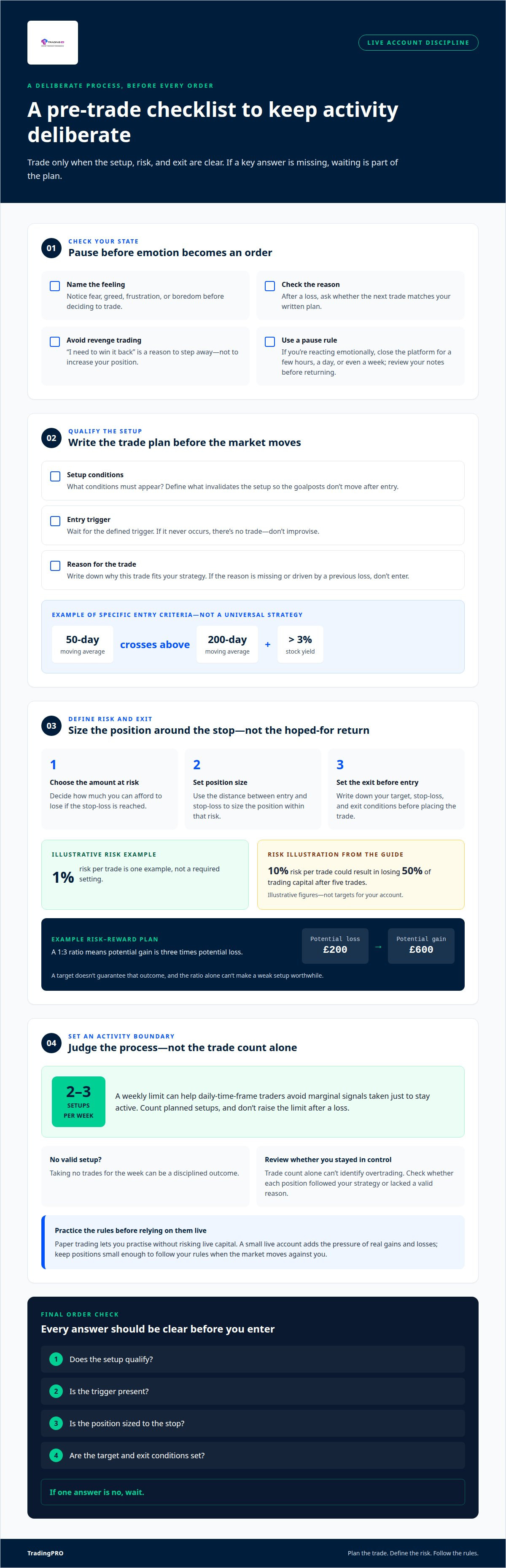
A checklist makes you pause before entering and can help prevent impulsive or revenge trading. Write down the setup, the reason for the trade, the planned position size, the exit conditions, and whether the trade still fits your strategy. If an answer is missing, or you’re trying to erase a previous loss, don’t enter.
Position sizing puts risk management into practice before emotions rise. Decide how much you can afford to lose if the stop-loss is reached, then size the position accordingly. A one-percent risk per trade is one example in trading guidance, while risking ten percent could result in losing fifty percent of your trading capital after five trades. Treat these figures as illustrations, not targets for your account.
Set a pause rule for stressful trades. Close the platform for a few hours, a day, or even a week if you’re reacting emotionally. Before returning, review your notes. The break creates distance between frustration and your next position, giving you time to assess whether your decisions still match your investment objectives.
FINRA Rule 2111 sets a relevant standard for recommended transactions. Under FINRA Rule 2111, quantitative suitability requires a reasonable basis to believe a series of recommended transactions is not excessive when considered together in light of the customer's investment profile. For your own trading, use the same discipline: assess repeated decisions as a pattern, not as isolated opportunities.
2. Defining trade setups, share allocation, targets, and stop-losses
Plan trades before the market moves. For each setup, write down the conditions that must appear, the entry trigger, position size, target, and stop-loss. If the trigger never occurs, there’s no trade. A practical way to learn how to avoid overtrading on your first live account is to treat an untriggered setup as a reason to wait, not improvise.
Make the setup testable. One example is waiting for the 50-day moving average to cross above the 200-day moving average, then requiring a stock yield greater than 3%. These conditions aren’t a universal strategy; they show how specific entry criteria can filter opportunities. Define what invalidates the setup, too, so you don’t keep moving the goalposts after entering.
Set your share allocation from the distance between entry and stop-loss. First decide how much you’re willing to risk on the trade. Then calculate a position size that keeps a stop-out within that amount. A 1% risk per trade is one possible example, not a required setting. Risking 10% per trade could result in losing 50% of trading capital after five trades, so avoid choosing a size simply because you want a faster return.
Choose the exit before entry. A 1:3 risk-reward ratio means the potential gain is three times the potential loss; one example pairs a maximum potential loss of £200 with a maximum potential gain of £600. A target doesn’t guarantee that outcome, and the ratio alone can’t make a weak setup worthwhile. Use the stop-loss and target to decide whether the trade fits your plan.
Set a clear activity limit for the week. A limit of two or three setups can help daily-time-frame traders avoid taking marginal signals just to stay active. Count planned setups, not just completed trades, and don’t raise the limit after a loss. If a week brings no valid setups, taking no trades is a disciplined outcome.
In the U.S., individual traders’ overtrading in their own accounts isn’t regulated by outside entities. Pattern day trading restrictions are separate account or broker constraints, so don’t treat them as your personal risk plan. FINRA Rule 3260 addresses excessive transactions in discretionary accounts relative to financial resources and account character. For a self-directed plan, your written entry, sizing, and exit rules remain central.
To understand how to avoid overtrading on your first live account, review your plan before each order: Does the setup qualify? Is the trigger present? Is the position sized to the stop? Are the target and exit conditions set? If one answer is no, wait. A structured trading account can be a next step when you’re ready to apply consistent rules to live trading.
3. Recognizing loss of control and overtrading
Trade count alone can’t tell you whether you’re overtrading. Fifty trades may be reasonable for an active trader, while more than 200 could signal excessive activity. The better test is whether each trade followed your strategy, or whether you kept entering positions without a valid reason. One position trader might overtrade by making a trade once a day if that pace doesn’t fit their approach.
Compare your activity with your own plan and market routine. For example, a trader watching a similar basket of currency pairs considered 40 trades in a month excessive. That count isn’t a universal limit. It becomes useful when you compare it with your strategy, time frame, and the number of genuine setups you identified.
Look for signs of lost control in your decisions. Are you entering because you missed an earlier move, adding trades after losing, or trading outside your planned hours? A trader who wakes at 3 am EST for the London open may also need to consider whether fatigue is weakening their judgment. The warning sign is a break from deliberate rules, not simply an early alarm.
A trading journal can reveal patterns that are hard to spot while placing orders. Record each trade’s time, setup, reason for entry, emotional state, and whether you followed your plan. At the end of the week, compare your notes with your trading activity. If several trades came from frustration or boredom rather than a setup, adjust your process and set a clear pause rule.
Use the journal to examine how your chart choices affect trade frequency. Tracking 20 currency pairs on hourly charts produces 480 hourly candles every 24 hours. On daily charts, the same 20 pairs produce 20 candles in a 24-hour period. Even reviewing half the hourly candles means tracking 240 candlesticks each day, creating many more chances to react.
More screen time doesn’t automatically mean better opportunities. A trader who checks every hourly candle may feel pressured to act, while a daily-chart trader can wait for fewer, more deliberate signals. Check whether your time frame supports your plan, and note when frequent chart checks lead to trades without a defined setup.
If your journal shows repeated rule-breaking, stop trading for a few hours, a day, or even a week. Use the break to review whether your recent activity still matches your objectives. Return only when you can explain what qualifies as a trade and what would make you stand aside. This turns a vague feeling of “too many trades” into specific behaviors you can change.
4. Risks of commissions, leverage, and account losses
Frequent trading can make transaction costs a steady drag on performance. Where commissions apply, each additional order adds a cost, whether the position wins or loses. Compare your account’s net result after trading costs with its result before those costs. If a strategy shows small gross profits but little or no net gain, review whether repeated entries are adding value.
Track costs by strategy, not just across your whole account. For each trade, record the commission and other transaction costs shown in your account activity, then group trades by setup. This can show whether an approach generates enough gains to offset its costs, or whether repeated attempts consume gains from stronger trades. Use this review to remove entries that don’t meet your criteria.
Leverage increases the market exposure attached to your position. It can magnify losses as well as gains, so a small price move may have a greater effect on account equity than an unleveraged position. Before using leverage, calculate how a move against you would affect your account and decide whether that loss fits your risk plan. Don’t increase exposure just to recover losses.
Short selling and margin trading carry risks that need particular attention. Losses from these trades can significantly increase risk and may leave you owing money to a broker. Before placing either trade, understand how the position could lose value, what would make you exit, and whether you can bear the potential loss. If those conditions aren’t clear, don’t take on that exposure.
Day trading can result in the total loss of your capital. Treat that possibility as a reason to protect your trading funds, not as a challenge to trade more aggressively. Keep money for essential expenses separate from trading capital, and stop placing trades when you reach your pre-set account limit. Frequent orders won’t automatically reverse a loss; they can add costs and exposure.
Broker conduct is a separate issue from a trader’s own decisions. In the United States, SEC Rule 15c1-7 governs broker conduct in discretionary accounts and may apply when a broker excessively trades a customer’s account to generate commissions. FINRA Rule 3260 also addresses excessive transactions in discretionary accounts relative to financial resources and account character. These rules concern broker conduct, not a personal trading-frequency target.
If you believe a broker has churned your account, investors can file a complaint with the SEC or FINRA. Keep account statements and trade records so you can clearly describe the activity and its effect on commissions. For your own decisions, review costs after each trading period and ask whether each order followed your plan. This helps distinguish normal strategy costs from activity driven by impulse.
5. How can beginners set daily loss limits and maximum drawdown rules?
Set limits before your next trading session, not after a loss. A daily loss limit tells you when to stop opening trades for that session; a maximum drawdown rule sets when to pause trading after account equity falls from its previous peak. These are personal risk controls, not universal figures. Choose boundaries that reflect your financial capacity and strategy, then write them into your trading plan.
First decide which losses count. Include closed-trade losses and account costs in your daily calculation. For open positions, choose whether the limit uses current unrealized losses or only completed trades. Current equity shows your live exposure; realized results alone can miss a position moving sharply against you. Apply your chosen method consistently.
For example, if you reach your daily limit while a position is still open, your rule should already specify what happens next. It might require closing the position and stopping for the session, rather than placing another trade to recover. Write the trigger and response together. A limit without a defined action is only a number on paper.
Set a separate drawdown boundary using your account’s high-water mark. When equity reaches a new peak, record it, then measure any later decline from that point. Decide in advance whether crossing your boundary means taking a break, reviewing your journal, or reducing trading activity. Unlike a daily limit, this reflects cumulative account decline, not just one session.
Test your rules against your own trading history before relying on them. Review losing streaks, position sizes, and account fluctuations in your journal. Ask whether the daily threshold would have stopped impulsive follow-up trades and whether the drawdown rule would have prompted a useful review. Adjust the limits if ordinary strategy fluctuations trigger them too easily, or if they’re so loose that they fail to constrain losses.
Make your rules practical. Record your starting equity, the session’s limit, the drawdown reference point, and the required response. After each session, update the figures and note whether you followed the stop condition. If you reach the limit, stop entering new trades; don’t widen it because a setup looks promising. Reassess your strategy before resuming.
A daily loss limit and maximum drawdown rule can contain risk, but neither prevents market losses or guarantees a specific outcome. They work only when your actions follow the thresholds you set. To put a written risk framework into practice on a live account, start your account registration.
TradingPRO
TradingPRO offers account options for different trading styles, including Rookie, Micro, Pro, and Scalp Accounts. Once you’ve defined your setup criteria, activity limits, and risk rules, choosing an account that fits your approach can be a practical next step. A clear plan still matters: an account type can’t make trading decisions for you or prevent overtrading. Use your rules to guide each position, and review your activity to see whether your process stays disciplined. If you’re ready to explore how TradingPRO fits your trading approach, contact TradingPRO.
Make your next trading decision intentional
Your first live account is a place to practise disciplined decision-making, not a reason to speed up. Treat trading as a process to refine: observe how you respond to real market conditions, learn from your records, and adjust your approach deliberately. That mindset is central to how to avoid overtrading on your first live account and build consistency over time.
TradingPRO offers Rookie, Micro, and Pro Accounts, giving traders options to consider when choosing an account suited to their approach. Choose the option that supports your plan, while remembering that you’re responsible for every trading decision and its risks.
Ready to discuss your trading approach and take the next step? Contact TradingPRO. Keep your rules clear, your decisions deliberate, and your progress grounded in the process.
Frequently Asked Questions
What is Overtrading?
Overtrading means trading more often, or with more exposure, than your strategy and risk capacity support. The issue isn’t simply how active you are, but whether your decisions respond to valid opportunities or pressure to stay involved. A trader can make frequent trades within a disciplined system, while even a few reactive trades can show poor control.
What is overtrading, and what are common signs of it in a new live trading account?
Overtrading happens when your decisions drift from a deliberate process. In a new live account, watch for placing orders outside your usual session, abandoning a setup after a small price move, or entering again immediately after closing a position. Changing your approach mid-session without reviewing why is another warning sign. Compare each order with your stated strategy, not just your account’s latest result.
How can new traders create a written trading plan with clear entry and exit rules?
Write a plan that someone else could follow without guessing what you mean. Specify the market conditions that make a setup valid, the price action that triggers entry, and what cancels the idea. Define what will prompt an exit if the trade moves in your favor or against you. Add a rule for unusual conditions, such as a sudden change in volatility, then review the plan after trading.
How many trades per day or week should a beginner make to avoid overtrading?
There’s no single suitable trade count for every beginner. The right pace depends on your strategy, market, and time frame: a setup-based approach may produce fewer valid opportunities than a short-term style. Set a limit that prevents you from taking marginal trades, then assess whether each entry met your criteria. If no setup qualifies during a session, making no trade is a complete decision.
What position sizing and risk-per-trade limits are appropriate for a first live account?
Decide what potential loss you can accept before choosing your position size. Then account for the distance between your entry and planned exit if the trade moves against you. A wider stop generally calls for a smaller position to keep the potential loss within your chosen boundary. Don’t copy another trader’s position size: account equity, instrument behavior, and your own tolerance all affect the decision.
How do trading fees, commissions, spreads, and slippage make overtrading more costly?
Each trade can incur costs that reduce its net result. Commissions may apply to transactions, spreads create a difference between buying and selling prices, and slippage occurs when execution differs from the requested price. These costs matter especially when a strategy relies on small price moves or frequent entries. Review completed orders and account activity to see how costs affect the results of your approach.
How can trading alerts, time limits, and scheduled breaks reduce excessive trading?
Use alerts to notify you when a planned price level or condition occurs, instead of watching every market move. Set a defined screen-time window around the period relevant to your strategy, and silence alerts unrelated to your setups. Schedule a break after a stressful trade or if you notice yourself checking repeatedly. These boundaries can reduce impulsive entries and keep your attention on decisions that fit your plan.


