


- Published on: 2026-11-22 12:18:39
How Long Do Broker Withdrawals Take? Processing and Arrival Times

Broker withdrawals don’t all move at the same speed. How long broker withdrawals take depends on the payment method and when the broker finishes processing: card withdrawals typically arrive within 3-5 business days, local bank transfers within 1-2 business days, and international bank transfers within 2-14 business days after processing. In rare cases, a card withdrawal can take up to 10 business days after processing.
It’s easy to focus on how long funds take to reach your account, but the broker’s processing time matters too. This guide explains how the withdrawal process works, when the estimated arrival window begins, and how verification, compliance checks, payment limits, and payment methods can affect timing. You’ll also learn why withdrawals may go back to the original deposit method and what can delay a request, so you can plan around each stage.
Key Takeaways
- Separate the broker’s processing stage from the payment provider’s transfer time to understand where a withdrawal may be waiting.
- Keep withdrawal details aligned with the account holder’s name and be ready to provide supporting documents if requested.
- Recognize how compliance reviews can add steps before funds are released.
- Review the payment method’s withdrawal limits and minimums before planning around a transfer.
- Choose a TradingPRO account type that fits your trading approach, from Rookie and Micro to Pro and Scalp.
Additional verification requirements
Additional verification means the broker requests documents or details before releasing a withdrawal. This can add a review stage, especially when the withdrawal amount or destination needs further checking. For example, a card payout that exceeds the original deposit may require a copy of the card. The broker may also ask for a card statement showing deposit transactions or evidence of the source of funds.
Withdrawal security and verification checks help confirm who owns the account and where the funds are going. A request may be paused while the broker reviews the information you submit. This is separate from the time a bank or card provider takes to deliver approved funds. Keep requested documents legible and make sure their details match the trading account and deposit method. Missing or inconsistent information can prompt follow-up requests and extend the review.
A verified bank account is a destination linked to the trading account holder’s identity. Withdrawals may need to go to a bank account or payment method registered in that holder’s name, rather than a third party’s account. This ownership match explains why a payout to a relative’s account or another person’s card may be declined. Use a destination that matches the name on the trading account.
Adding a new bank account can lead to an additional review when you request a withdrawal to that destination. The broker may need evidence linking the account to its holder before approving payment. A bank statement can confirm the account details, while a statement showing the original or most recent deposit may help establish the payment history. The exact documents depend on what the broker needs to review.
If a card is lost, damaged, or cancelled, the broker may ask for a letter from the card-issuing bank confirming its status. A bank statement showing the original or latest deposit may also be requested. These documents can clarify where the funds came from and why the original card can’t receive a payout.
- Card payout: A copy of the card may be requested when the withdrawal exceeds the original card deposit.
- Deposit evidence: A card statement showing deposit transactions may support the review.
- Source of funds: Additional proof may be requested before funds are released.
- Account ownership: A third-party destination may not be accepted if it isn’t registered to the trading account holder.
Submit requested documents through the broker’s designated account process. A clear response that addresses the specific request can help avoid further questions, but verification must be completed before processing continues.
How will my withdrawal be processed?
A withdrawal has two timing stages: broker processing and payment-provider delivery. The estimated arrival window starts after the broker processes the request, not necessarily when you submit it.
Broker and Provider Processing Times
Broker processing time is the period between submitting a withdrawal and the broker releasing it to the payment network. Payment-provider arrival time is the transfer period after release, until funds reach your bank account or card. These are separate stages. For example, a bank transfer estimate of 1-2 business days applies after processing, so a review beforehand adds time to the overall wait.
Check the request status to identify its current stage. A pending request is still with the broker; a processed request has moved to the next stage. Weekends, bank holidays, incomplete verification, and payment-network handling can affect when funds arrive. Keep the submission time and status update handy in case you need to follow up about a delay.
Processing by Payment Method
Processing by payment method means the broker sends approved funds through the route selected for the withdrawal. Local bank transfers are credited within 1-2 business days after processing, while international bank transfers take 2-14 business days. Credit and debit card withdrawals typically arrive within 3-5 business days after processing; rare cases can take up to 10 business days.
Brokerages normally return funds to the same payment method used for the deposit. A card refund may therefore follow a different timeline from a bank transfer, even if both requests were submitted on the same day. Check which route applies before estimating arrival. Once the broker releases the withdrawal, the payment provider controls the final delivery.
Settlement Before Withdrawal
Settlement is the completion of a trade’s financial transaction before its proceeds become available to withdraw. A sale may appear in your trading balance before the proceeds are eligible for transfer. The withdrawal timeline starts only after settlement requirements are met and the broker has processed the request.
Settlement times vary across brokerage transactions. The asset traded, the market, and the applicable settlement schedule determine when proceeds can be withdrawn. If your cash balance includes recent sales, distinguish settled funds from amounts still awaiting settlement. This explains why a balance that appears available may not yet be eligible for withdrawal.
Are brokerage withdrawals taxable, and what tax forms or penalties may apply? Tax treatment depends on your country, account type, and transaction; tax forms and penalties also vary by jurisdiction. A withdrawal itself may not determine the tax outcome, so distinguish moving cash from realizing investment gains.
Do brokers charge fees for ACH, wire, or check withdrawals, and how much? Fees depend on the broker and withdrawal route, so there is no universal amount. Review the fee information shown for your selected method before submitting a request.
For a smoother trading setup, begin with account registration and keep your withdrawal details consistent with your account information.
Delays for legal or regulatory compliance
A compliance review is an assessment of a withdrawal before funds are released. It helps the broker resolve questions about an account, transaction, or destination. This review is separate from the bank’s transfer time. For example, a request can remain under review before the bank receives payment instructions.
A review may begin when transaction details need clarification or differ from the information already held on the account. A change of destination, unusual account activity, or a withdrawal that does not fit the account’s transaction history can prompt closer examination. These are possible triggers, not a universal checklist. The key point is that a request may need assessment before processing continues.
Compliance checks may also confirm that a withdrawal follows the broker’s procedures and applicable requirements. The broker may review account activity related to the request, the payment route, and relevant supporting information. If those details raise a question, the request can be paused while the issue is assessed. This happens before the payment provider’s arrival window begins.
A request for clarification is a separate review stage, not a delay caused by the bank. For example, if the broker asks you to explain a transaction, processing may remain paused until your explanation is received and reviewed. Responding to the exact question helps move the review forward. A partial response may leave the issue unresolved.
- Account activity: A reviewer may compare the withdrawal with the trading account’s transaction history.
- Payment details: A destination or payment route that needs clarification can delay release.
- Supporting information: A specific request can keep processing paused until the broker assesses the response.
Separate review time from transfer time when estimating arrival. The bank’s delivery window starts after the broker releases the funds, so any compliance review comes first. A transfer may follow its usual route after approval but still arrive later overall because the broker needed additional time to review it.
Use the withdrawal status to identify the current stage. A pending or review status means the broker still has work to complete; a processed status indicates the request has moved forward. If the status changes after you submit information, note the update and any new instructions. This helps you understand whether the next step is broker review or payment delivery.
Keep your response focused. Answer the question raised, use consistent account details, and avoid sending unrelated documents that do not address the issue. A clear response can reduce avoidable back-and-forth while the broker completes the required assessment before releasing the withdrawal.
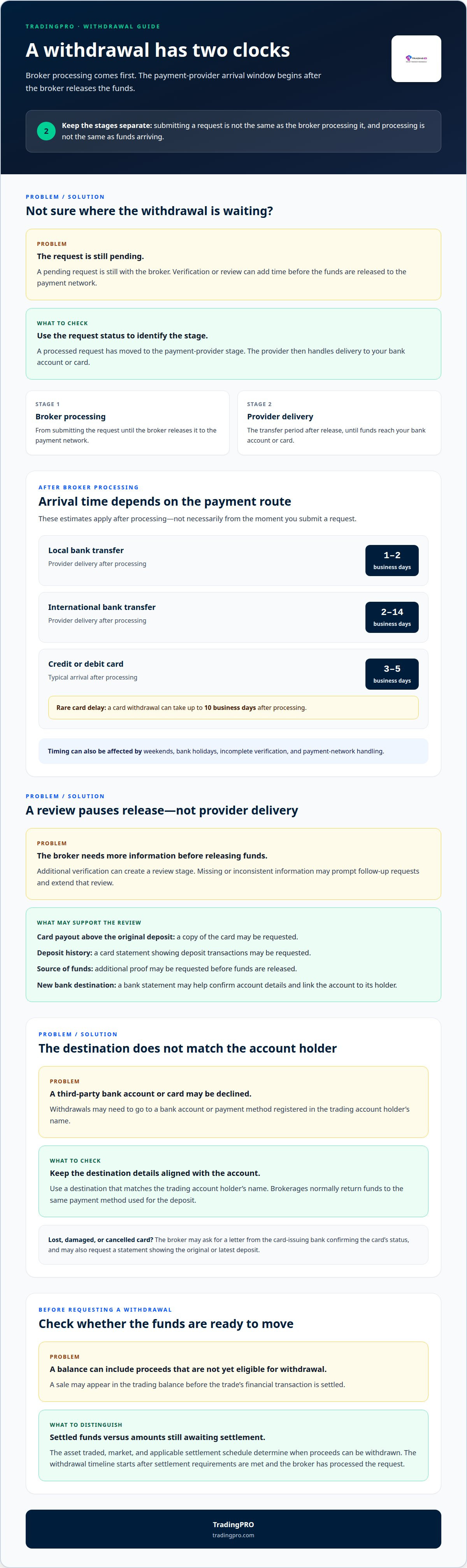
Estimated withdrawal arrival by payment method
An arrival estimate is how long funds usually take to reach a payment destination after broker processing. The payment route matters: local and international bank transfers have different timelines, while card withdrawals follow their own process.
Treat these estimates as payment-provider delivery times, not the total time from submitting a request. Broker review and processing come first. The ranges below begin after processing.
- Local bank transfer: credited within 1-2 business days after processing.
- International bank transfer: credited within 2-14 business days after processing.
- Credit or debit card: typically received within 3-5 business days after processing; rare cases can take up to 10 business days.
A local transfer generally has a shorter stated arrival window than an international transfer. Cross-border routing can involve additional handling between financial institutions, which helps explain the wider 2-14 business-day range. Card payouts follow a separate route, and their typical window is 3-5 business days after processing.
Business days are the days used for transfer estimates, not every calendar day. Weekends and bank holidays can therefore affect the date funds arrive. The broker’s processing schedule determines its withdrawal cutoff times, and payment-provider schedules also affect timing. A request submitted after a cutoff may enter processing later than one submitted before it.
To estimate the likely arrival date, identify the destination method and the date the broker marks the withdrawal as processed. Then count the applicable business-day window from that point. For example, a processed local transfer uses the 1-2 business-day estimate, while an international transfer uses 2-14 business days. A card withdrawal typically uses 3-5 business days.
Brokerages normally return withdrawals to the same payment method used for the deposit. The route may therefore depend on how you funded the account, not just on your preferred destination. For example, a deposit made by card may be returned to that card rather than sent by bank transfer.
If a card payout has not arrived within its typical 3-5 business-day window, remember that rare cases can take up to 10 business days after processing. For a bank transfer, compare the elapsed business days with its local or international range. Also distinguish an approved, processed withdrawal from one still awaiting broker review, since the arrival window starts after processing.
Withdrawal limits and minimums
A withdrawal limit restricts how much money you can request through an account or payment method. A minimum is the smallest amount accepted for a withdrawal. These conditions can affect whether a request proceeds as submitted, so review them along with the payout route.
Limits may apply per transaction, over a period, or to a particular payment method. The applicable rule determines whether a single request is within the limit. For example, if a request exceeds a transaction cap, it may need to be reduced or divided, depending on the broker’s process. Revising the request can add a step before processing begins.
A minimum works in the opposite direction. If the amount requested is below the method’s minimum, the withdrawal may not be accepted through that route. The amount available to withdraw may also differ from the displayed account balance if some funds are unsettled or otherwise unavailable. Check the eligible balance and method requirement before submitting.
Per-transaction limits define the amount allowed in a single withdrawal request. A platform may set a separate cap for one request and an overall limit, so don’t treat them as interchangeable. If a request is too large for one transaction, splitting it can create separate processing events rather than one combined transfer.
Payment-method limits are restrictions tied to the chosen destination, such as a bank transfer or card payout. The permitted amount can determine which withdrawal route is available. Because withdrawals are normally returned to the payment method used for the deposit, that method’s limits may apply.
Minimum withdrawal amounts set the lowest amount you can request as a payout. A small remaining balance may not meet the minimum for a particular method. In that case, the funds may need to remain in the account until they meet the minimum or be withdrawn through another permitted route.
Limits can affect timing before the payment provider receives the funds. If a request needs to be revised, divided, or redirected, the broker must process that change. The payment provider’s arrival window begins only after processing, so an extra step can extend the overall timeline without changing the provider’s transfer speed.
Before submitting, match the requested amount to the available balance, the selected method, and any applicable minimum or cap. If the amount does not fit, adjust the request to meet the relevant condition. Create a trading account to get started with a trading setup built around your goals.
TradingPRO
TradingPRO offers account options designed for different trading approaches. Its Rookie, Micro, Pro, and Scalp Accounts provide distinct environments, helping you choose an account that aligns with your experience and style. Understanding processing stages, destination methods, and withdrawal requirements can also help you plan how trading funds move in and out of your account. Timing depends on broker processing and the payment provider’s delivery window, so use the details in this guide to set realistic expectations. If you’re comparing account types, consider which environment best fits your approach. Contact TradingPRO to discuss your next step.
Plan your next move with confidence
Build withdrawal timing into your wider trading plan rather than treating a payout as an afterthought. Understanding how long broker withdrawals take helps set realistic expectations, allocate funds with purpose, and avoid relying on an assumed arrival date. Use the payment route and processing status to guide your planning, and leave room for review or transfer delays.
Your next step is to choose a trading setup that suits your goals and approach. TradingPRO offers account options for different trading styles, giving you a place to develop your strategy while keeping account and withdrawal processes in view. If you’re ready to move forward, contact TradingPRO about your next step.
Plan ahead, follow each stage, and keep your trading decisions focused on the information available.
Frequently Asked Questions
How does a broker process a withdrawal request, and what information must clients provide?
The broker reviews your request and checks account and payment details before releasing approved funds through the selected route. You may need to provide identity or payment evidence if requested. For example, a card statement can show deposit transactions, while source-of-funds documents can clarify how funds entered the account. Use a withdrawal destination in the account holder’s name and submit documents that directly address the request.
How does a broker handle withdrawal requests when clients have open positions?
Open positions don’t automatically make your entire account balance available for withdrawal. Brokers generally assess available cash and any funds needed to support remaining trades. For example, a request that would leave insufficient funds for open positions may be limited or declined under the broker’s account rules. Check the withdrawable balance shown in your account instead of assuming all displayed equity can be paid out.
Why haven't I received my money?
Your request may still be under broker review, awaiting requested information, or moving through the payment provider’s network. To answer “How long do broker withdrawals take?”, first check the request status and look for a message requesting documents or clarification. Then compare the processing date with the delivery window for your selected payment route. If the broker marks the payment as sent but the funds haven’t appeared, contact the broker with the withdrawal reference and destination details so it can trace the transaction.
How long do brokerage account withdrawals take by ACH, wire transfer, check, and debit card?
Timing depends on the route and starts after broker processing. Local bank transfers are credited within 1-2 business days; international transfers take 2-14 business days. Debit and credit card withdrawals typically arrive within 3-5 business days, with rare cases taking up to 10 business days. ACH and check delivery depend on the broker’s processing and the payment network, so allow for their separate handling stages.
Why is a brokerage withdrawal pending or delayed, and how can I resolve it?
A withdrawal may remain pending while the broker reviews account details, confirms payment ownership, or assesses supporting documents. Open your account’s status or message center and identify the outstanding step. If documents are requested, send clear copies that address the request; if payment details need correction, use an eligible destination in the account holder’s name. Keep the request reference and status updates for follow-up. If you’re still wondering, “How long do broker withdrawals take?”, use the current status to identify what is affecting your request.
What are typical brokerage withdrawal cutoff times, weekends, and holiday delays?
Weekends and bank holidays can affect when funds arrive. The estimated arrival window begins after the broker processes the request.


