


- Published on: 2026-10-23 10:17:06
Copy trading fees and the costs that affect your total spend

The headline fee rarely tells the whole story. A copy trading fee structure can include subscription, management, and performance fees, alongside trading costs such as spreads and overnight swaps; platforms don’t all charge the same combination. The total depends on which fees apply and when they’re charged.
It’s easy to focus on a single commission and miss the costs that build up around copied trades. Compare the full picture instead: how fees are calculated, whether they’re charged monthly or against profits, and how trading activity affects your net return.
This guide explains the main copy trading fees, when they may apply, and what to compare across platforms. You’ll get a clearer view of total costs before deciding whether a platform’s fee model suits your approach.
Key Takeaways
- Compare subscription and management charges by both amount and billing period; a low upfront fee may not mean lower costs over time.
- Include spreads, commissions, and overnight swaps in your cost comparison, since trading activity can affect your net return.
- Find out when performance fees are triggered and whether they apply to new profits or recovery gains.
- Compare platforms using the same trading assumptions, then assess how each fee model fits the strategy you plan to copy.
- Review the account options available for different trading styles before choosing the setup that suits your approach.
What Fees Are Involved in Copy Trading?
Copy trading costs can include subscriptions, management charges, and performance fees.
Subscription and Management Fees
A subscription is a recurring charge for copying a trader, while a management fee is calculated against account equity. These charges may apply even when copied trades produce no profit.
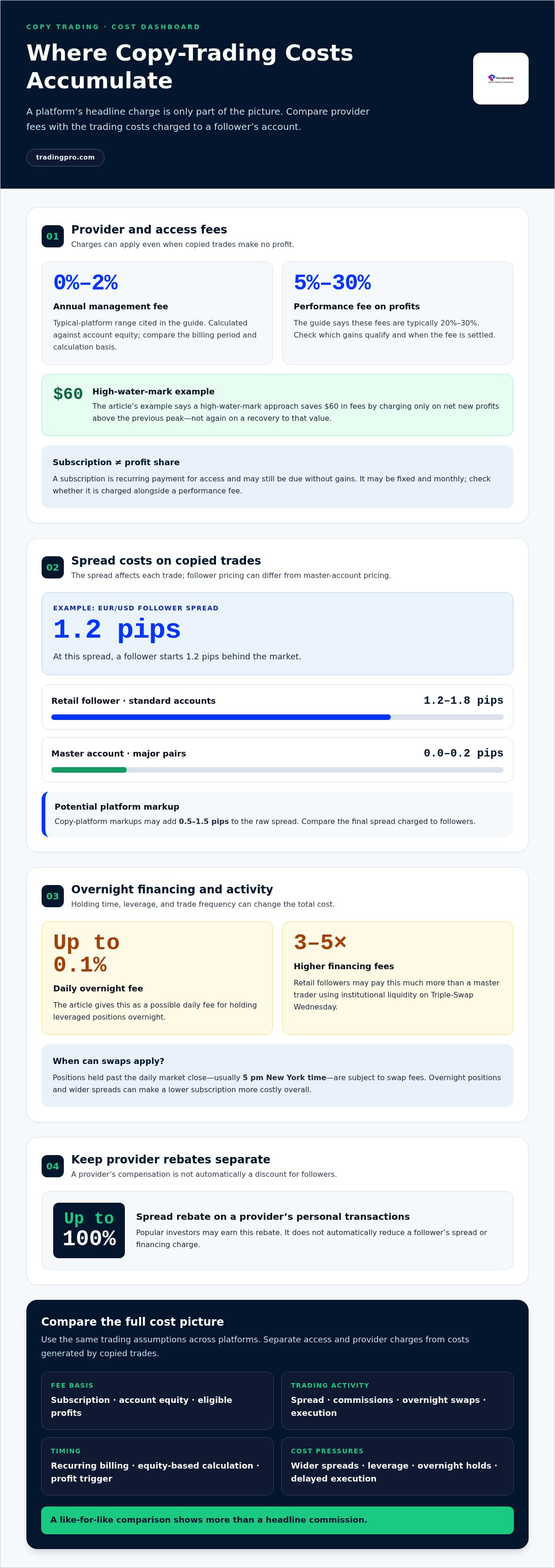
Annual management fees on typical platforms range from 0% to 2%. Compare the billing period and calculation basis, not just the headline rate. A subscription may be fixed, while an equity-based charge changes as the account value changes.
Performance Fees and High-Water Marks
A performance fee is a share of gains paid to a trader or strategy provider. Copy-trading performance fees range from 5% to 30% of profits, and are typically 20% to 30%.
A high-water mark sets the previous peak that an account must exceed before new performance fees apply. A genuine high-water-mark model charges only on net new profits above that peak. This protects a follower from paying again on a recovery to an earlier account value. In one example, the high-water-mark approach saves $60 in fees.
Leader Compensation Through Subscriptions
A strategy provider may charge each follower a flat monthly subscription for access to their strategy. This model links compensation to access, not the follower’s profits, so the charge may still be due when copied trades have not generated gains.
Compare this arrangement with a performance fee before copying. Check whether a separate subscription also applies, and whether both charges can be made. The copy trading fee structure affects how much profit remains after the strategy’s charges.
Fee Disclosure and Payment Responsibility
Are copy trading fees disclosed before you copy a trader? Platforms typically set out applicable charges in their fee schedules or copying terms. Review whether each charge recurs, is based on account equity, or is triggered by profit.
Who pays trading fees in copy trading: the follower or the strategy provider? The follower’s account generally bears costs generated by copied trades, such as spreads and execution charges. A provider may separately receive a subscription or a share of profits. Keep these costs distinct: provider compensation does not replace trading fees charged to the follower’s account.
The overall cost depends on the platform’s billing model, account equity, trading activity, and holding periods. The exact figure is given in a quote for your case.
How Do Copy Trading Costs Compare Across Platforms?
Compare each platform’s trading costs, not just its headline commission. Spreads, overnight swaps, subscriptions, and execution differences can all reduce the capital left after copying trades.
What risks can increase the total cost of copy trading? Wider spreads, overnight financing, leverage, and delayed execution can raise costs, particularly during volatile markets. Losing trades can also leave charges payable while reducing account equity.
Spreads and broker markups
A spread is the difference between an asset’s buy and sell prices, and it affects each copied trade. A 1.2-pip EUR/USD spread means a follower starts 1.2 pips behind the market. Copy-platform markups may add 0.5 to 1.5 pips to the raw spread, so compare the final spread charged to followers.
Retail follower spreads on standard accounts may be 1.2-1.8 pips, compared with master-account spreads of 0.0 to 0.2 pips on major pairs. That gap matters when copying frequently.
Swaps, subscriptions, and trading activity
Positions held past the daily market close, usually 5 pm New York time, are subject to swap fees. Overnight fees for holding leveraged positions can be up to 0.1% daily. Retail followers may pay 3 to 5 times more in financing fees than a master trader using institutional liquidity on Triple-Swap Wednesday.
Subscriptions are another cost to compare. Weigh the recurring charge against the number of copied trades and their trading costs. A lower subscription can still mean higher overall spending if wider spreads or overnight positions dominate.
Rebates and total-cost comparisons
Popular investors may earn a spread rebate of up to 100% on their personal transactions. Treat that separately from the costs charged to followers. A rebate to the strategy provider doesn’t automatically reduce a follower’s spread or financing charge.
Use a like-for-like example when comparing platforms.
Check how each platform applies costs to your copied activity, including the spread, trade frequency, and positions held overnight. A copy trading account setup is a practical next step for exploring copy trading alongside these cost factors.
Fee payout timing and triggers
Copy-trading charges may follow a calendar, an account-value calculation, or a profit trigger. For signal providers, this determines whether money is deducted monthly, annually, or only after qualifying gains. Track each charge against the account balance and the event that triggers it.
Calendar-based charges
A flat subscription is tied to access, not the outcome of copied positions. Followers may pay a provider a monthly subscription even when the strategy has not made a profit. The billing date and renewal terms determine when the balance is reduced.
Management fees use a different basis: account equity. The fee may accrue throughout the year, while the actual deduction follows the platform’s billing schedule. Distinguish the accrual period from the payout date. A monthly subscription and an annual management fee can therefore reduce the balance at different times.
Before copying, map each charge to its timing: subscription renewal, management-fee calculation, or performance-fee settlement. This helps show which costs may be deducted while positions remain open and whether a balance change came from trading activity or a scheduled fee.
Profit-based triggers
Performance fees are triggered by eligible gains, and platforms may charge them weekly or monthly. The settlement period matters because a profit recorded in one period may be treated differently from a later recovery. For example, a 20% performance fee on 1,000 in gains deducts 200 from the trader’s gains.
The account is still below its earlier high, but the reset treats the recovery gain as fee-eligible. This timing rule can materially change the balance available for future copying.
High-water-mark settlement
A genuine high-water mark triggers performance fees only on net new profits above the previous equity peak. After a decline, gains first restore the account toward that level; they are not new profits while the account remains below the mark.
In the example, the account rebounds by 500 in Month 3 and gains 100 in Month 4. The high-water-mark example saves $60 in fees. By contrast, periodic reset models can result in 15-25% in total fees over a 12-month volatile market cycle while the account is in a net loss. Compare the reset schedule and trigger before copying, not just the stated performance-fee rate.
Commissions
A commission is a transaction charge for executing a trade, not simply for following a signal. In copy trading, it may be added to spreads, swaps, subscriptions, or performance fees. Separate each charge to see what copying activity actually costs.
How commissions apply
A commission may be calculated per trade, by trade size, or by the instrument traded. The method matters because a strategy’s trading frequency can multiply transaction charges. For example, if a signal provider makes around 40 trades in a month, a per-trade commission can apply repeatedly across that activity.
Trade size also affects the calculation when commission is based on volume. Retail brokers commonly require minimum position increments of 0.01 lots. If a copied signal is adjusted to fit a follower’s balance, the executed size may differ from the provider’s position, changing the commission calculation. Compare the follower’s actual trade size, not just the signal provider’s history.
Commission versus other charges
Don’t treat a narrow spread as proof that a trade is commission-free. A platform may charge a separate commission alongside its spread arrangement. Likewise, a subscription pays for access, while a commission relates to executed trades. Check each charge separately, including how it applies to different instruments.
A useful comparison is to trace one copied position from opening to closing. Identify the entry commission, any cost of holding the position, and the closing commission. Then compare the total with the trade’s gross result. A losing trade can still incur transaction charges, so commission affects both profitable and unprofitable outcomes.
Reading the full cost model
Use a consistent activity profile when comparing commission models. For example, compare platforms using the same signal provider, instruments, trade frequency, and follower allocation. If one provider trades around 40 times monthly and another trades less often, a per-trade charge can make their totals diverge even when the listed rate looks similar.
Also distinguish commissions from margin requirements. A 10x multiplier applied to 6-lot trades requires 60k margin in the stated example; that is capital committed to support positions, not a commission paid for execution. Keeping those categories separate prevents you from misreading the balance impact or assuming you only pay when a trade closes.
Before copying, review whether each charge applies automatically to every executed position, varies with volume, or depends on the instrument. Compare those rules with any subscription and the strategy’s trading pattern. This gives you a clearer estimate of transaction costs without confusing commissions with capital held as margin.
Comparing copy-trading platforms
Compare platforms using the same signal, allocation, and trading period. Gross returns alone can hide differences in spreads, commissions, and execution. Calculate what remains after costs, then assess whether the copied strategy suits your goals and risk limits.
Match the comparison assumptions
Start with a consistent allocation. In proportional copying, if an investor commits 1% of their portfolio to a position, the copier may also allocate 1%. That lets you compare how each platform applies costs to similar copied trades, rather than mistaking different position sizes for a fee difference.
Next, compare the instruments and holding patterns. A strategy that trades frequently can have a different total cost from one that holds positions overnight. Include spreads, commissions, and swaps in the same calculation. Keep subscriptions separate, then add them to trading costs for a complete view.
Account for execution differences
Copying a signal involves execution time as well as the stated fee schedule. Routing latency is estimated at 120ms to 300ms or more. In calm markets, slippage may be 0.1-0.2 pips, while high-volatility events can move prices 3-8 pips within 200ms. These differences can affect the entry price and eventual returns.
Compare the strategy provider’s trade price with the follower’s actual execution price across the same sample. A recommended hard maximum slippage threshold is 0.8 pips. This gives you a clear limit for evaluating execution quality, rather than relying on advertised spreads alone. Include both calm and volatile conditions in the review.
Compare the risks, not just the headline cost
Leverage and allocation settings can change the capital exposed to each copied signal. Compare how trade sizes scale with your balance, and consider whether a platform lets you set limits independently. A hard equity stop, such as a 10% balance drop, is one example of a separate risk control. It doesn’t remove market risk, but it defines a point for reviewing exposure.
Use a like-for-like comparison sheet: record the instrument, copied position size, spread, commission, overnight cost, and execution difference. Then compare net returns over the same period. Don’t rank platforms by subscription fees alone; the lowest recurring charge may not mean the lowest total cost when trading activity differs.
Ready to put your copy-trading comparison into practice? Open an account to explore copy trading and assess the setup against your own cost criteria.
TradingPRO: Rookie Account
TradingPRO’s Rookie Account is a next step for readers exploring copy trading and comparing account options. Use the fee factors in this guide to frame your decision: distinguish trading costs from provider compensation, then consider how the account tier fits your trading approach.
TradingPRO also offers Micro Account, Pro Account, and Scalp Account options. Consider these account tiers alongside Social Trading / Copy Trading, rather than treating a low headline fee as the only decision point. Focus on the costs of copied activity and the account setup you want to use.
Explore the Rookie Account details, then visit tradingpro.com to learn more about TradingPRO.
Make Your Next Copy-Trading Decision Deliberate
Turn your fee review into a decision rule. Before copying a signal, decide how you’ll assess its costs against your goals, how much capital you’re prepared to expose, and what would prompt you to reassess. A clear rule helps you stay consistent as market conditions or trading activity shift.
Choosing an account is part of that decision. TradingPRO offers Rookie Account, Micro Account, and Pro Account options to consider alongside your copy trading approach. Use your understanding of the copy trading fee structure to compare the setup with your priorities, rather than focusing on a single charge or headline return.
Take the next step at a pace that suits you. Contact TradingPRO to discuss your options and explore a setup aligned with your trading plans. Move forward with a clear view of your priorities and confidence in the decision you make.
Frequently Asked Questions
What Is Profit-Sharing in Copy Trading?
Profit-sharing is an arrangement in which a strategy provider receives an agreed portion of eligible gains made by followers. This share is separate from the costs of executing trades, so a profitable copied position can still leave the follower with less than its gross gain. Before copying, identify how eligible profit is defined, how losses are handled, and how the provider’s share is calculated.
What is a performance fee?
A performance fee is compensation linked to gains rather than access to a strategy. Its calculation may depend on which profits qualify, the measurement period, and whether earlier losses affect eligibility. For example, applying a stated percentage to gross gains can produce a different deduction from applying the same rate after trading costs. Read the calculation basis as well as the rate.
What fees do copy trading platforms charge?
Platforms may charge for access to a trader, account management, successful performance, or execution of copied orders. The combination matters: recurring charges may apply even when activity is low, while transaction costs depend on trades and instruments. Build a checklist that separates platform charges from position-level costs, then assess the total against your expected activity.
Do copy trading platforms charge a subscription or performance fee?
Some platforms charge subscriptions, others use performance-based compensation, and some apply both. A subscription pays for access according to its billing terms; a performance fee depends on qualifying gains. For example, a follower who copies infrequently may assess a recurring subscription differently from someone whose chosen provider trades actively. Compare the fee trigger and billing schedule, not just the label.
What are typical copy trading commission rates and minimum fees?
There is no single commission rate or minimum fee across copy trading. Charges can depend on the instrument, trade size, and whether commission is calculated per side or across the completed transaction. Review the schedule for minimum charges as well as volume-based rates. Under the same pricing method, a small copied order can be affected differently from a larger one.
Are there spreads, overnight financing, or transaction fees for copied trades?
Yes. A copied order can incur the same types of position-level costs as other trades, including spreads, applicable overnight financing, and transaction charges. The instrument and holding period determine which costs apply. A position closed within the trading session may avoid overnight financing, while one held beyond the market close can incur it. Check how each cost appears in the account record.
How do copy trading fees compare across major U.S.-available platforms?
Compare U.S.-available platforms by their full cost models, not by one advertised charge. Copy trading fees can combine access charges, performance compensation, and execution costs, each with different calculation rules. Use the same hypothetical strategy and allocation for each comparison, then assess when fees are charged and how copied orders are priced. This reveals which differences matter for your trading pattern.


