


- Published on: 2026-10-27 09:52:16
Benefits of professional trader status and who may qualify

The biggest tax advantage comes with a specific election, not simply an active trading schedule. The benefits of professional trader status can include deducting ordinary and necessary trading-business expenses; with a valid Section 475(f) mark-to-market election, eligible traders may treat trading gains and losses as ordinary rather than capital. According to the Internal Revenue Service, the annual deduction limit for net capital losses is $3,000, a limit that mark-to-market treatment can change.
Active trading alone doesn’t automatically qualify you for trader status. The IRS considers the purpose, scale, frequency, continuity, and regularity of your trading, as well as the time you devote to it. No form automatically grants this status.
This guide explains how the IRS distinguishes traders from investors, which factors matter most, and what tax advantages and trade-offs may follow. It also explains why trader status and a mark-to-market election are separate considerations, so you can understand the rules and how they relate to your trading activity.
Key Takeaways
- Learn how the IRS distinguishes a securities trader from an investor by examining trading purpose, activity, continuity and regularity.
- Understand how trader status differs from a Section 475(f) mark-to-market election, and why the distinction can affect how gains and losses are treated.
- Identify the activity patterns and records that can help show whether your trading is substantial and consistent.
- Weigh potential business-expense deductions against tax trade-offs, including the consequences of an accounting election.
- See how TradingPRO’s Rookie Account can support your trading journey while you learn the tax rules that apply to your activity.
Tax Status - Trader or Investor?
For U.S. federal tax purposes, frequent trading doesn’t automatically make someone a securities trader. The IRS distinguishes traders from investors by looking at the activity’s purpose and how it is conducted. Traders seek to profit from daily securities-price movements; investors generally seek dividends or long-term capital appreciation. This distinction can affect how trading gains, losses, and expenses are reported.
Investor status is generally the starting classification when securities are held for investment rather than traded as a business. The Internal Revenue Service sets the annual deduction limit for net capital losses at $3,000, or $1,500 for married taxpayers filing separately. A net capital loss beyond the applicable limit may generally be carried forward to later tax years, subject to tax rules.
Trader status depends on the pattern of activity, not a label on a tax return. Relevant indicators include typical holding periods, transaction frequency and dollar amount, the purpose of the income, and time spent trading. Short holding periods and regular activity focused on short-term price movements can support trader treatment. Securities held mainly for dividends or long-term growth point toward investment activity.
IRS Publication 550 describes traders as conducting substantial activity regularly, frequently, and continuously to profit from short-term market movements. There’s no court-approved minimum trade count that automatically qualifies someone. One person’s high transaction count may still be inconsistent or investment-oriented, while another’s pattern may show an ongoing trading business. The overall facts matter more than a single number.
Trader status and a mark-to-market election are separate decisions. A qualifying trader without a valid Section 475(f) election generally reports securities sale gains and losses as capital gains and losses, subject to capital-loss limits and wash-sale rules. With a valid election, covered trading gains and losses are generally treated as ordinary, and wash-sale rules don’t apply to those trades. The election changes tax accounting; it doesn’t itself establish trader status.
For example, an investor who sells securities at a loss may have deductions limited by the annual capital-loss rule, while a trader’s treatment depends on classification and any election. According to the Internal Revenue Service, a wash-sale loss may be deferred when the same stock is bought within 30 days before or after a loss sale. That rule can affect investors who sell and quickly re-enter a position.
To document and report trader tax status, keep records showing transaction dates, securities, holding periods, amounts, and the time and purpose of trading activity. Report qualifying business deductions on Schedule C within Form 1040, or through a separate business entity’s return; no IRS form automatically grants trader status.
Keep consistent records throughout the tax year. Trade confirmations, account statements, expense receipts, and a trading log can connect reported activity to its purpose and pattern. Record investment activity separately from trading activity, especially if the same securities appear in both. This distinction supports clearer reporting and helps show which tax treatment applies to each transaction.
IRS criteria for trader-in-securities status
The IRS evaluates the trading operation as a whole, not a title on a brokerage account or tax return. To qualify as a securities trader, a taxpayer must seek to profit from daily price movements. The activity must also be substantial and carried on with continuity and regularity. A portfolio held mainly for dividends or long-term appreciation points toward investing, not trading. Understanding the benefits of professional trader status starts with these activity tests.
Three questions frame the eligibility test: What income does the activity seek? How substantial is it? Does it operate consistently? Trade records can show whether transactions target short-term gains or build long-term investment positions. A calendar can show whether trading happens regularly, while account statements can document transaction size and frequency. Together, these records show the pattern more clearly than a single busy week.
No court-approved minimum trade count automatically qualifies a taxpayer. Court decisions show why volume alone is not decisive. In Commissioner v. Nubar, 137 transactions in a year supported trader status. In Estate of Yaeger v. Commissioner, over 1,000 transactions per year did not qualify the taxpayer. The difference lies in the broader trading pattern and purpose, not a simple threshold.
Holsinger & Mickler v. Commissioner offers another clear comparison: 372 trades over 110 days did not establish trader status. The number of active days, gaps in activity, holding periods, and the taxpayer’s income objective all help explain why. A high total can still look like occasional investing if trades cluster in short bursts or positions remain held for longer-term returns.
Time devoted to securities activity can strengthen the picture. Trading for about 75% of the week is described as an accepted parameter for trader tax status. That figure is an indicator, not a stand-alone test. A consistent schedule tied to short-term market movements carries more weight than time spent monitoring a portfolio designed for dividends or capital appreciation. The potential benefits of professional trader status depend on the facts behind that schedule, not the time figure alone.
The relevant securities category also matters. Internal Revenue Code section 475(c)(2) describes securities relevant to trader rules. The IRS criteria concern securities traded for the taxpayer’s own account; dealer activity falls under a separate tax definition. Keep investment holdings distinguishable in your records, especially when the same securities appear in both portfolios.
To build a clear evidence trail, organize statements, trade confirmations, holding-period details, and a dated activity log. Record why a position was opened and closed, then compare that purpose with the actual pattern. If you’re ready to put an active trading routine into practice, create a trading account and keep tax classification separate from account setup.
Requirements for trader tax status
Trader tax status and a Section 475(f) election are separate tax decisions. The first concerns whether your securities activity qualifies as a trading business. The second changes how covered gains and losses are treated for income tax. A valid election doesn’t establish trader status, and qualifying as a trader doesn’t automatically make the election for you.
For the 2026 tax year, existing calendar-year individuals generally had to make the Section 475 election by April 15, 2026. The election required a timely filed 2025 return or timely extension request. Taxpayers seeking the election were instructed to submit Form 4868 with a written declaration of intent. The election must precede the tax year for which it applies.
Timing matters because a late Section 475(f) election is generally not allowed. For a new taxpayer who wasn’t required to file a return for the prior year, the election may be made within 2 months and 15 days after the first day of the effective tax year. IRS Publication 550 describes the procedures. These deadlines concern the accounting election, not an automatic application for trader classification.
Changing accounting methods has its own filing step. A trader changing from a non-mark-to-market method for securities must file Form 3115 under Revenue Procedure 2025-23, Section 24.01. Existing mark-to-market traders who haven’t already made the election also use Form 3115 for the year the change takes effect. Keep the election statement, filed return, extension, and accounting records together.
Once made, the election generally remains in effect. Revoking it requires a notification by the tax return due date, without extensions, for the year before revocation takes effect. A trader who revoked a Section 475(f) election and seeks to make it again within five years must use non-automatic procedures for the required Form 3115 filing. Treat this as a consequential accounting choice, not a yearly preference.
For reporting, traders with a valid mark-to-market election generally report covered trading gains and losses as ordinary rather than capital. Form 4797 is used for those gains and losses. Without a valid election, securities sales generally remain subject to capital-loss limits and wash-sale rules. Keep securities held for investment identified in records on the day of acquisition, separate from the trading portfolio.
Before filing, assemble the trading activity records that support trader classification, then review election timing and accounting treatment separately. A return should reflect the activity actually conducted and the election properly made for that tax year. For example, a taxpayer may qualify as a trader yet continue reporting securities gains and losses under capital rules if no valid Section 475(f) election applies.
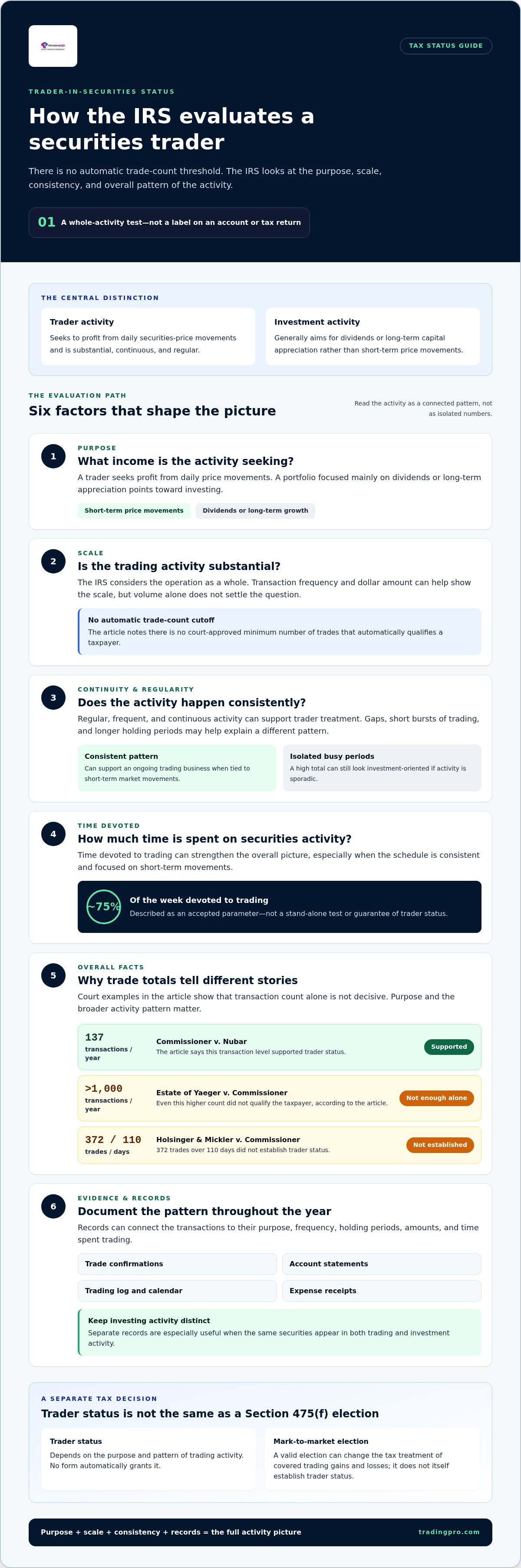
Factors used to assess trader status
The IRS weighs the taxpayer’s full trading pattern, not one impressive result. Key considerations include typical holding periods, trade frequency and dollar amount, the purpose of the income, and time devoted to trading. Each factor adds context. A high-volume year, for example, may still reflect investment activity if positions target long-term growth rather than short-term price movements.
Start with the activity’s purpose. A taxpayer seeking profit from daily securities-price movements presents a different case from someone pursuing dividends or long-term appreciation. Transaction records should make that purpose clear. For each position, note its opening and closing dates, the strategy behind it, and whether the outcome depended on a short-term price move or a longer-term investment thesis.
Holding periods give the IRS another practical signal. In the Poppe case, the taxpayer’s stocks and options were largely held for less than one month in 2015. That short duration aligned with an effort to capture near-term market moves. Compare it with positions held for extended periods, where expected capital growth or dividend income may better explain the activity.
Frequency must be viewed alongside the calendar. In Poppe, the taxpayer made about 60 trades per month and spent four to five hours per trading day on trading activity. Those details illustrate how trade count and time commitment can reinforce each other. Keep a dated log of sessions, research, order placement, and review so the tax return reflects the activity’s regularity.
Dollar amount and financial results also enter the picture, but profit alone doesn’t establish trader status. In Assaderaghi, first-year gross trading receipts were $2,659,696 in 2014. That substantial figure was one part of the record, not a stand-alone qualification rule. The IRS considers receipts in context with transaction frequency, holding periods, and the taxpayer’s purpose.
Time spent should relate directly to the trading operation. Record market research, strategy development, trade execution, and bookkeeping separately from unrelated work or passive account monitoring. A calendar paired with brokerage records can show whether the activity operates as a continuing business. An advisor reviewing the records can compare the stated purpose with actual trading behavior.
Business expenses should relate to the same activity. Software, computer equipment, and advisory fees may support a claim if they are ordinary and necessary for the trading business. Keep receipts and record the business purpose of each expense. Expenses alone don’t establish trader status; they provide context when trading records also show substantial, continuous activity seeking profit.
Make the evidence consistent before filing. Match trade confirmations to the activity log, separate investment holdings from trading positions, and check that the tax return’s treatment reflects the documented facts. A taxpayer with short holding periods, recurring trading sessions, and a short-term profit objective presents a different profile from someone whose account mainly holds dividend-paying investments.
What are the risks and disadvantages of claiming trader tax status?
Trader tax status doesn’t make every tax outcome more favorable. The key trade-off often comes from choosing Section 475(f) mark-to-market accounting. Under that election, covered trading gains and losses are generally treated as ordinary rather than capital. That can change the treatment of losses, but professional trading income doesn’t qualify for reduced long-term capital-gains rates.
Mark-to-market accounting also changes when gains and losses enter the tax calculation. Open positions are treated as sold at fair market value on the last day of the year, making unrealized gains or losses reportable. A trader may therefore owe tax on gains from positions still held at year-end, even without selling them for cash.
The election can be difficult to reverse. Section 475(f) generally remains in effect, and changing back requires IRS permission. A trader who wants to revoke the election must follow the applicable notification procedure. The decision affects accounting treatment beyond a single trade, so weigh the election against your strategies, expected holding periods, and ability to maintain consistent records.
Classification also requires supporting documentation. A taxpayer must be able to substantiate the trading activity reported, including its purpose, frequency, continuity, and business expenses. If brokerage statements show long-held investments while the return treats the entire account as a trading business, that mismatch can weaken the reporting position. Keep investment holdings distinct from trading positions in your records.
Trader status doesn’t provide legal protection for personal assets. A stock portfolio remains personally exposed to lawsuits, so tax classification isn’t a substitute for legal separation or asset protection. The tax label describes how trading activity is treated; it doesn’t create a separate legal person or shield a taxpayer’s assets from claims.
Tax treatment also involves trade-offs with investment flexibility. Investors may receive reduced rates on long-term capital gains, futures, and qualified dividends. Traders focused on short-term price movements may not receive those same long-term capital-gains benefits for professional trading income. Compare your actual holding patterns and income sources before treating every securities position alike.
Before making a Section 475(f) election, map its effects on gains, losses, open positions, and future accounting changes. Keep a record of the election, transaction history, and separate investment holdings. A tax advisor can assess how those details fit your return and trading operation. If you’re ready to build your own trading routine, open a TradingPRO account.
TradingPRO: Rookie Account
TradingPRO’s Rookie Account is an option to consider as you build a trading routine and learn which approach fits your goals. It provides access to a trading environment, but it doesn’t determine your IRS tax classification or replace tax records. Keep your trading activity, investment holdings, and tax reporting organized separately.
As your approach develops, TradingPRO also offers Micro, Pro, and Scalp Account options for different trading styles. Choose an account based on the trading environment you want, not on the assumption that an account tier grants professional tax status. IRS classification depends on your actual securities activity and the applicable tax rules.
Visit tradingpro.com to explore the Rookie Account and available account options.
Make your next trading move with purpose
Your next step is to align your trading routine with your goals, risk tolerance, and recordkeeping habits. The benefits of professional trader status matter only when your activity and tax treatment fit the rules; a trading account alone doesn’t establish tax classification. Keep that distinction clear as you plan your approach.
TradingPRO offers Rookie Account, Micro Account, and Pro Account options for different trading approaches. Choose the account that fits how you want to participate, while keeping tax decisions grounded in your actual trading activity. If you’re weighing your next move, explore TradingPRO’s account options and take a focused step toward your trading goals.
Build with discipline, keep your records organized, and move forward with confidence.
Frequently Asked Questions
What does professional trader status mean for U.S. tax purposes?
It means securities activity may be treated as a trading business for federal tax purposes when the facts support that classification. It doesn’t describe a job title or depend on what a brokerage account is called. A securities dealer is a separate category under Internal Revenue Code section 475(c)(1). Taxpayers can also report a trading portfolio and separate investment activity differently, keeping their records clear about each portfolio’s purpose.
What are the IRS requirements for qualifying as a trader in securities?
Your activity must seek profit from daily securities-price movements, be substantial, and show continuity and regularity. The IRS considers the overall pattern, including holding periods, transaction frequency and size, income purpose, and time spent. No court-approved minimum trade count guarantees qualification. A busy stretch followed by long gaps, for example, may tell a different story from sustained activity aimed at short-term market moves.
What tax benefits can trader tax status provide?
Qualifying traders may deduct ordinary and necessary business expenses tied to trading, such as eligible software costs. A separate Section 475(f) mark-to-market election can change how covered gains and losses are reported, treating them as ordinary rather than capital. That may affect the treatment of losses, but it isn’t automatic with trader status. The benefits depend on the activity and accounting treatment actually reported.
Can traders deduct business expenses, and which expenses qualify?
Yes, qualifying traders may deduct ordinary and necessary expenses related to their trading business. Examples include trading software, computer equipment, advisory fees, interest, and educational costs such as trading seminars. The expense must connect to the business rather than personal investing. Keep receipts and record the business purpose, such as noting which software supports trade analysis. IRS Publication 535 discusses common business expenses relevant to these deductions.
How does trader tax status affect wash-sale rules and capital loss limits?
Trader status alone doesn’t remove wash-sale rules or capital-loss limits. With a valid Section 475(f) mark-to-market election, covered trades are generally exempt from wash-sale rules and capital-loss limitations under section 475(d)(1). For other trades, the Internal Revenue Service says a wash-sale loss may be deferred when the same stock is bought within 30 days before or after a loss sale. Track each position and its tax treatment.
What is the difference between trader tax status and investor status?
Traders seek to profit from short-term price movements through substantial, regular activity; investors generally pursue dividends or longer-term appreciation. This distinction affects how income, losses, and expenses may be reported. A taxpayer can have both types of activity, but should distinguish investment securities in records from the day of acquisition. For example, a long-term holding can remain an investment while separate, actively traded positions form part of a trading operation.


